PROMOTE THE HOBBY

PROMOTE THE HOBBY THROUGH OPEN MINDED EXCHANGE OF KNOWLEDGE AND IDEAS - Share your experiences as a breeder or novice both good and bad. Pass on your experiences and share results with the next generation. A successful breeder will be remembered for such efforts...

Thursday, May 23, 2013

Some Days The Postman Brings Better Mail Than Others...

Some Days The Postman Brings Better Mail Than Others...

© Alan S. Bias
Permission granted for nonprofit reproduction or duplication of photos and text with proper credit for learning purposes only.

2013 IFGA Michigan Guppy Breeders Show Results
Blue, Red, Green and Yellow.  Four bags and four little round stickers.  Each bag containing a single Vienna Lower Sword.  The folks at my local Post Office still are not quite sure what all the fuss is about.  They have come to accept my near weekly mailings of guppies in Styrofoam boxes.  Always handling them with a much gentler touch than I when moving a box from counter to bin, or at least in my presence.  What they are less familiar with is when a recognizable box shipped the prior week returns on nearly the same day the following week.  They have come to understand my prized show entries are returning from a long journey to locales they have never had a chance to visit themselves...

So, what drives an adult individual, myself, to spend the greater part of a year or more in producing a single fish only to pack it in a plastic bag and mail it across the country?  Much less spend many years or even decades in developing them into a recognizable strain?  As a teenager the desire to  raise guppies was already long in place.  This after my late father had put one of his tanks in front of my high-chair while still a toddler.  In the early 1960's he had started keeping common types of guppies and at one time built up to six or more tanks.  This, according to what he told me in later years.  None had filtration to my knowledge.  Instead relying on frequent water change, floating plants and low stocking rates.  Similar to research laboratories of old.  One container in particular stands out in my mind to this day.  It was a large round bowl with a flat bottom.  If memory serves, it was likely 5 gallons or more in volume.  Purchased while he was stationed in Orleans, France and intended as a large goldfish bowl. If my addition is correct, I've been keeping and breeding guppies in some form or fashion for nearly 44 years.  From the age of 8 I have been maintaining my own tanks of guppies in attempt to propagate strains and explore the hidden world of guppy genetics.

I am also pretty sure the large round bowl met its demise at my hands in one of many moves after nearly a decade of service.  My first real tank was a meta-frame 10 gallon tank with colored gravel and a corner box filter.  No polyester floss in use in 1969, it was charged with fiberglass angle-hair and real charcoal.  Lighting a simple incandescent bulb in a metal fixture.  Heaters at this time were a luxury, and heat generated from the light fixture served in its place.

My first tank contained a basic population of fish for the day;  a single cori, a zebra danio, a pair of guppies, and a neon tetra or two.  At this time my dad was posted to his last duty station Fort Ord, CA after returning from Vietnam.  I distinctly remember going to the local department store in neighboring Monterrey, CA and being able to pick out a couple Neon Tetra's at .99 cents apiece.  On another visit a wonderful pair of Half Black Reds, likely from Florida farm stocks.  From the first litter produced by this female I was able to raise about a dozen males in the same simple ten gallon setup to equal the size of their sire.  A feat I could hardly accomplish today with pet shop stocks.   A very viable strain.

By the age of 10-12 I had accumulated a greater number of tanks than my father had at his peak level of interest.  I was also very busy de-evolving every fixed strain available at local pet shops   One could hardly call it breeding as I really had no idea what comprised a strain, much less how to maintain it.  Within several years I had managed to read most commercial publications of the time focusing on guppies or live-bearers in general.  Being a teenager and living in central Virginia in the early 1970's made guppy breeders about as accessible as going to the moon.  No thoughts of attending a show in person.  Such notions belonged to those living in big cities.  Guppy breeders were mysterious group of  names appearing  in the "For Sale" section of a couple monthly aquatic publications or infrequent photos in a rare book.

This all would change for me in my early twenties, a year or so after first joining the International Fancy Guppy Association (IFGA).  Initially the only benefit of membership consisted of a monthly bulletin and addresses to purchase stock.  My first real contact with an actual living breathing IFGA member came in the form of a phone call from a newly retired Florida Breeder, actually two.  With it came an invitation to drive 300 miles roundtrip to their homes and see a real Fishroom.  A drive that would become a regular occurrence on my part for the better part of a decade.  They had both retired and moved to coastal Eastern Virginia.  A small town  called Irvington located on a peninsula referred to as the Northern Neck.

From my first meeting with this gentleman, I realized not only had I found a true friend, but a mentor into the world of breeding guppies.  He knew no strangers and offered not only his knowledge, but also his stocks freely.  His name was Elvin C. Cooney.  Known to guppy breeders as "Old Man Cooney" or simply "Cooney".  His stories were not limited to guppies, but that of life in general.  From bounty trapping 300 skunks one year as a youth in his Pennsylvania hometown to help cloth his family during the winter and frequenting the home of a notable scientist named Albert Einstein while a mere lad.  


A. S. Bias (l) & Elvin C. "Old Man" Cooney ca 1990
In the company of Old Man Cooney I would attend not only my first IFGA Annual, but many more in the following years.    Cooney liked to breed Black Delta's and Half Black females.  To this day the largest females I have ever seen were in his tanks and nearly three years of age.  For the next several years with Bill Schoenbauer in tow we would make our yearly trip to an IFGA show.  As he told it, it seems Bill had been shot down 3 times in his military service. He also indicated if we wished to fly to a show we were welcome to go ourselves, as no one could order him to do so after retiring.  Bill also liked to breed Black Delta Guppies and also Red Albino's.  A review of the IFGA yearly class totals during the 1980's will reveal their successes.   Bill hated too drive and Cooney had trouble sexing his litters, much less driving on a crowded highway.  So the three of us traveled many miles by car with me at the wheel.  One would think the age differences of a twenty year old traveling with two 65+ year old men would leave little in common.  In truth, it was just the opposite as we all enjoyed breeding guppies and associating with those who also did so.

 Blond Schimmelpennig Platinum DS, 1st place 2012 Gateway Guppy Associates 
For the most part stock breeding is a personal adventure.  A solitary relationship between you, your breeding program and fishroom.  Yet, a breeder does not have to be a loner.  Benefit is often derived from focusing on other aspects outside the fishroom.  In my case it reduces time spent in the fishroom and allows more time for results to mature.  There are many facets that comprise the world of guppy breeding.  Friendships formed,  knowledge garnered and passed down to others, club meetings, publication of results, and stock exchanged.

2011 World Guppy Contest Winner
One thing most livestock breeders like to do is share the success of their results in some form or fashion.  Be it in conversation with a local breeder, written publication, sale of stock, or entry in a show.   Help support the future of the IFGA, your local club, and guppy breeding in general.  Send a couple of your best fish to a show.  Priority mail is still an inexpensive and  reliable means of transport.   Entry fees have remained constant for a number of years, often at the expense of the host club.

Who knows in the end you may find that, some days the Postman brings better mail than others... 


Blond Vienna LS with Purple Body Mutation

~~~~~~~~~~~~~~~~~~~~~~~~~~~~~~~~

 Set your goals wisely and obtain foundation stocks geared to meet them.  It is much easier to build upon the positive results and knowledge of successful breeders than to start from scratch.


Tuesday, May 7, 2013

The IFGA Gold Body Class ...A Phenotype in Need of Genetic Clarification

The IFGA Gold Body Class   ...A Phenotype in Need of Genetic Clarification


© Alan S. Bias
Permission granted for nonprofit reproduction or duplication of photos and text with proper credit for learning purposes only.


Normally IFGA phenotypic classification of color and pattern does a pretty good job based on its primary intent.  A means to avoid confrontation during a show based on divergent interpretations of genetics while judging.  It is a way to separate genotype from phenotype and simply view things for how they appear at a particular moment.  A visual "snapshot in time" if you wish.  Inconsistent lighting issues at shows aside, in most cases this system works as well as any found in similar livestock judging venues, allowing for amicable results.  But not always.  Case in point the IFGA Gold Body Class.

Definitions:
1.  IFGA AOC color class is defined as any color not covered by another recognized show class as determined by body or caudal color.
2.  IFGA Gold color class is defined by basic body color with no regard to "color pigment" in either body or caudal. It is comprised of fish that are homozygous double recessive for  Blond (bb) and Metal (Mg).  In many instances they are also triple recessive for Purple Body Mutation (Pb).  

IFGA Gold Body Color Class Male w/Pb (Courtesy Bryan Chin and  RMGA) 
                                 
The following excerpts show current IFGA classifications for male Guppies as taken from the most recent Judging Booklet:

Photo text courtesy of  International Fancy Guppy Association (IFGA)

Requirements for "IFGA Gold" as a body class are simply stated as:  "A Minimum of 25% of a yellow gold color in the body".  In the Classification for Show Entries chart IFGA Gold breaks out after 1.  Swordtails, 2. Albinos and 3-4. Body Patterns for HalfBlack (HB) and Snakeskin (SSB).  It is followed by Caudal Color.  A further note indicates:  "Bronze and gold-bodied fish will be classified by the appropriate body color.  These body colors referring to autosomal recessives Golden (gg) - IFGA Bronze and Blond (bb) + Metal (Mg) - IFGA Gold.   Under Color Clarifications it is further stated: "Gold:  Will be defined by basic body color (25% yellow gold color)".  This "yellow gold color" in essence results from a metal overlay on a blond fish.

What follows is an excerpt from "Judging Guppies" by Stan Shubel under the section pertaining to Body Color.  As incorporated into to the IFGA Judging Booklet for the judging of Male Guppies.
Photo Text courtesy of  International Fancy Guppy Association (IFGA)

Genetically, I interpret this to mean not all homozygyous Blond (bb) fish will meet the requirements for IFGA Gold Color Class.  As they do not incorporate a 2nd autosomal recessive for Metal (Mg) in homozygous form.  Many such fish, while possibly heterozygous for Mg lack homozygous metal expression and are not considered "IFGA Gold".   Many authors in the past have simply stated, "The IFGA refers to blond as gold".  This is not necessarily true.  The IFGA does not recognize, or at least actively promote, the term "blond" as it is a "published genotype".   This has created a large void in phenotypical descriptors in North America.  It may be a better conclusion to state: "The IFGA has no terminology for blond".  As such Blond fish in the IFGA lacking Mg are normally shown by tail color classes (in theory with corresponding matching body color pigment) or in the AOC or Pastel classes when they fail to meet cutoffs in other class requirements.   AOC classed fish are more likely to be simple Blonds with or without Pb, and lacking solid colored finnage for entry into Red, Green, Blue, Black, Yellow, Pastel or Purple caudal color classes.  Blond males lacking Half-Black simply default to a color class based on caudal color.

IFGA AOC Color Class Male w/Pb (Courtesy Bryan Chin and  RMGA)

IFGA AOC Color Class Male w/PB (Courtesy Bryan Chin and  RMGA)
Each of the two above examples are basically homozygous Blond (bb) fish with at a minimum additional autosomes for Purple Body Mutation (Pb) and Zebrinus (Ze).  What each visibly lacks in genotype is autosomal Metal (Mg) in homozygous form needed to be phenotypically classed as IFGA Gold.  It is likely these males are part of a strain bred for competition in the IFGA Gold class.  In other parts of the world such fish would be referred to both by genotype and phenotype as blond.  In North America by those outside IFGA circles as blond both by genotype and phenotype.  As the IFGA has neither terminology or classes for "Blond" fish they are considered AOC's.

IFGA Gold Body Color Class Female w/HB (Courtesy Bryan Chin and  RMGA) 

The following excerpts show current IFGA classifications for female Guppies as taken from the most recent Judging Booklet:
Photo text courtesy of  International Fancy Guppy Association (IFGA)

Photo text courtesy of  International Fancy Guppy Association (IFGA)
IFGA Gold females often express X-linked Half-Black (NiII) and are allowable in the Gold Female Color class.  While their sibling males are more likely entered in the Yellow or AOC Color classes.  Again, it must be remembered the IFGA color classes are determined solely by phenotype and not genotype.  As a result Half-Black (NiII) is "visibly recognized" only in grey bodied fish based on phenotypical expression.  It should be conceded that blond fish do visibly express a "weakened" version of NiII.  For comparison, in the following photo is presented a grey bodied female w/Mg.  While expressing "Gold Pigment" in finnage, she lacks both blond and NiII to enhance expression in body.

Grey Mg Vienna LS female (Bred by Alan S. Bias)
Discussion:  Body color and pattern in guppies is controlled by regulation within segmented regions in both body and finnage.   Often in "combination" from both sex-link and autosomal traits or in "complex"  from linked gene(s).  Additionally regulation is often distinct in body and finnage under separate controlling mechanisms.  Metal is regularly expressed in:  1.  Body, 2.  Body and finnage, or 3. Just finnage.  The two following blond IFGA delta males visibly express Mg in the caudal, but appear to lack it in the body.   IFGA Gold  only takes into consideration "body color" and not in finnage.   While blond, as a result of lacking Mg in the body they can only be classed as AOC or Pastel.  

IFGA AOC Pastel Males (Courtesy Bryan Chin and  RMGA)
Metal is present in many guppgies, including IFGA strains, not classified as IFGA Gold.  The "yellow sheen" visible in IFGA Apple Green Delta are a direct result of Mg.   Mg can be found in both grey and blond bodied fish.  It is found in several different segmented regions as "standalone" patches, overlaying color pigment or as part of larger regions such as the shoulders in Schimmelpennig Platinums.  Metal is expressed in the following grey bodied Green Male in both the peduncle and at the juncture of the caudal base.  It is also evident in the shoulder if you look closely.
IFGA Green Delta (Courtesy Bryan Chin and  RMGA)
Initial misconceptions about the IFGA Gold class may have resulted from limited visual representation.  When contemplated in the 1960's it is doubtful a true representative photo would have been possible by anyone less than a professional photographer.  Only within the last decade or two have photographers begun to capture the true essence of an IFGA Gold as something much more complex than a simple blond guppy.
Photo text courtesy of  International Fancy Guppy Association (IFGA)
While specific to IFGA Bronze, the above criteria is also reflective of IFGA Gold.  No consideration in "pointing" is given within IFGA standards for additional "color pigment" in the body or finnage.  This is further compounded by a "Bias" of Judges towards color pigment in IFGA Golds, especially in the form of yellow.  In most instances iridophore differentiation is readily distinguished from yellow color pigment.  Reflective qualities are the result of guanine or purine crystals, and not flat color pigment.  So many IFGA Gold's are disqualified for additional yellow pigment it is nearly shunned by breeders.  Improvements upon the "Golimowski Type" IFGA Gold with pastel / white finnage have been nearly non-existent, resulting in a stagnation of the color class.

Blond Lower Sword w/Mg (bred by Alan S. Bias)
In the above example are two sibling males.  The upper is a Grey Lower Sword w/Mg and yellow pigment.  The lower is a Blond Lower Sword w/Mg and yellow pigment.  The latter would meet IFGA criteria for IFGA Gold class if he possessed a delta tail.  I photographed these two males with deflected flash after a period of nearly two hours in total darkness, sometime after midnight.  The purpose was two fold;  1.  First to show motility of yellow color pigment, in that the fish are able to "turn it off", 2.  Second to show that yellow metal iridophores are not (or at least very minimally) reactive to reduced light and motility.

Attempts by breeders, such as Luke Roebuck and others, to show "improved" delta strains within the IFGA Gold class have, to date, met with resistance.  While I visualize and breed my guppies based on phenotype, for understanding I often interpret results as an expression of genotype.  Unfortunately, this is in direct contradiction to IFGA phenotypical judging.  Breeder successes in improved "Golds" resulting from combinations of Metal (Mg) + Asian Blau (Ab) + Blond (bb) can result in near full body expression.  This form of amplification of expression via combination is similar to Asian bred Full Platinum's that result from Metal (Mg) + Half-Black (NiII) + Blond (bb) .  Yet, in combination with yellow pigment such fish are only regularly "downgraded" to Yellow Delta classes when not disqualified.  Despite IFGA Gold body color being determined prior to (Yellow) Caudal Color on IFGA classification charts.  There continues to be a lack of willingness to accept "Full Golds" on equal terms to traditional IFGA Golds with patches of metal and translucent regions of color.   All that is required is a minimum of 25% gold body color, in the form of Metal (Mg) in combination with Blond (bb) with or without Purple Body Mutation (Pb).
Asian Blau Schimmelpennig Platinum (bred by Alan S. Bias)

Herman Magoshitz Full Yellow w/Mg (photo courtesy Luke Roebuck)

Summary:  During the past 15 years I have primarily concentrated my breeding's heavily on both gold  iridophore pigment and yellow color pigment in Lower and Double Swords.  Both in grey and blond body fish.   I have found each to be extremely "moody" in nature.  The yellow color pigment by direct influence of the mood of fish as individuals or stress related events, and the gold iridophore pigment by autosomal influence.  Otherwise, the latter is fairly static.  Over the last three years I have additionally focused on the addition of Asian Blau (Ab) to this equation.  In general, in the mornings my entire fishroom can appear as tank after tank of white finned fish with gold striping in the fins and body.  By early afternoon in natural or handheld incandescent lighting it is just the opposite.  Tank after tank of yellow finned fish.  The following photographs exemplify the effects of metal in both grey and blond fish.  Some of which would meet criteria for IFGA Gold if in delta form.

Grey Vienna w/Mg (bred by Alan S. Bias)
Asian Blau Grey Vienna w/Mg (bred by Alan S. Bias)
Blond Vienna w/Mg (bred by Alan S. Bias)
Asian Blau Blond Vienna w/Mg (bred by Alan S. Bias)
Grey Vienna Pb w/Mg (bred by Alan S. Bias)
Asian Blau Grey Vienna Pb w/Mg (bred by Alan S. Bias)
Blond Vienna Pb w/Mg (bred by Alan S. Bias)
Asian Blau Blond Vienna Pb w/Mg (bred by Alan S. Bias)

 ~~~~~~~~~~~~~~~~~~~~~~~~~~~~~

There is often no right or wrong when it comes to raising Guppies.
  Though sometimes a better course of action to meet desired results.
  Post your results in publication or by entry in a show.
  Help Guppy Breeding persevere.  

~~~~~~~~~~~~~~~~~~~~~~

Sunday, January 20, 2013

Longevity as a Guppy Breeder; a shared single common trait?


Longevity as a Guppy Breeder; a shared common single trait?

© Alan S. Bias
Permission granted for nonprofit reproduction or duplication of photos and text with proper credit for learning purposes only.
January 20, 2013
Blond Vienna Lower Sword


Have you ever noticed when visiting a breeder, attending a show, sale or meeting those that stand out?  Not in the traditional sense of being the most well-known for breeding stock, show results or breed promotion.  I’m referring to those who have been around for years.   …and years.   …and years.  Likely to be around for many more years.  These breeders all share a single common trait

It really does not matter what strain of guppy they prefer to raise.  It does not have to be a guppy at all.  For that matter it does not have to be a fish.  These individuals are found in all venues of livestock breeding and have a passion for what they do.

There is a common philosophy in the world of large animal livestock breeding that basically states; a new breeder will be around for 3-5 years.  If you are marketing pedigree seed stock this is the time frame you have to work with.  Most individuals are attracted to a particular species or variant within a species for a host of reasons.  Breed preservation and ornamentation aside, initially for many attraction starts with eye appeal or as something new.  For a smaller subset of breeders it will fall under genetic potential.  Be it for marketability or research and study.  Each group normally has a set period of “longevity” within the breed.   In each case a clock has been set in motion, and as it winds down so does involvement with not only the animal, its maintenance and propagation, but interest in associating with fellow breeders.

Grey Vienna LS w/Mg

As long as you actively breed it will largely be by pattern as decided by Mother Nature and influenced by your actions.  If primary interest is showing, timing has been largely decided for you.  If genetic study some freedom of choice is allowed in timing.   Simple pleasure allows for the most freedom of choice in choosing if and when to breed.  The basic cycle is as follows:

1.      Obtain needed resources to house and feed your initial stock,
2.      Choose your breeders and mate them,
3.      Rear your young and evaluate them,
4.      Cull for genetic and environmental defects,
5.      Adjust feed rations for age classes and cull those that do not meet expectations,
6.      Retain superior offspring for grow out,
7.      Market individuals and your breeding program through sales / exhibition / show,
8.      Review both feed and environmental inputs,
9.      Determine progress towards program goals,
10.  Adjust and obtain food resources / space, in accordance with retained animal numbers,
11.  Balance breedings and direction by consideration of potential new breeders.

Grey Vienna LS w/blue peduncle, Z-bar and X-link yellow

A true stock farmer garners a sense of appreciation not only from the end result, but the effort to produce it.  One of the first breeder groups to normally meet their demise is associated with limited interest in farming livestock.  Those who quickly realize that raising animals takes a lot of time, effort and resources.  It is often dirty, mundane and repetitive.  Often they are in it for the wrong reason; time to kill, money to spend,  or impress peers, friends and neighbors.  These individuals have the shortest clock.  It was never wound that far.

Breeding livestock is on slow time.    Regardless of breed of choice, rearing livestock is cyclical in nature.   Your goals should be defined and stated from the start; define your breed plan.  These well help determine your longevity.  If not you will likely doom yourself to failure, and in so doing lesson your interest.  In a fast paced society many breeders fail to adjust to these requirements.  This is the second group to meet their demise.  The clock was wound a bit further, but not long enough.

Those that make it past the initial 3-5 years will often survive for 8-10 years or more.  This grouping is comprised of overlapping interests to include:   A.  Commercial, B.  Showing, C.  Researcher, both professional and amateur,  D.  Dabblers, E. Genetic Breeders.

A.    Commercial breeders are just that, in it for the monetary value.  Individuals or farms may show in the process to help market results.  Others will not.  In the end their clock length is solely determined by how long they are able to profit from the venture.  In many cases demise is not realized until long after they are gone.

B.   Most breeders, regardless of level of interest will have some familiarity with the names of top show breeders.  This elite group will always have a revolving door and membership will come and go.  If you wish to verify this statement, review the names of class champions for a set period of time.  It is surprising to see how many individuals have come and gone as they are often the first to burn themselves out.  Others persist while showing less with passing time.  Some are easily recalled having left their mark for a specific breeding strain(s) which has been passed down.  Others, not nearly so as sights were set on point totals with limited overall genetic contribution.  The clock for each not only seems to wind down, but often stops abruptly.   

C.  Sometime back I read an online posting by a fellow breeder and friend whose stated primary interest has always been research in nature.  In short he pondered why an active breeder would devote time and effort to promote guppies as a hobby.   His stated goals and objectives had been satisfied.  For this individual the clock has nearly wound down.  Time will tell if he is able to revitalize his interests, thereby add more time to the clock.         

As a rule, most researchers, both professional and amateur, from the start have a set longevity.  It normally encompasses a specific grant, a portion of their career or is limited to a single, sometimes broad scope of research.  At the end of which we can hopefully expect to benefit from publication of results, which can be amalgamated with that of others, and passed down to future generations.  It seems few have the ability to evolve this narrow focused mode of interest into another, with less rigidity, that will add time to their clock.  Invariably, they too have a clock that comes to an abrupt halt.

D.  Comprising the bulk of breeders, Dabblers loosely follow the rules, though to their own interpretations.  Many have been around for uncounted years and make appearances at annual functions or regional events.  Seem to leave and re-enter active breeding status on multiple occasions for many reasons.  Have varied interests and are often a good source of buyers for “serious” breeders.   Sometimes producing a quality end result and others not.  Often, inadvertent preserving genetic diversity.  More often than not they are happy with their level of interest and degree of involvement.  Frequently being one who regularly devotes time at local venues.  While their clock often needs repair to add time, it seems to run for some time thereafter. 

E.   This group is comprised of elite breeders with the most overlapping interests.  They are by far the professional breeders who produce true foundation pedigree livestock.  Without them there would be no stock breeding as we know it.  Such individuals gain the knowledge needed to produce reliable breeding strains, via consistency, research and study.  Have the ability to balance a sustainable breeding program regardless of fish-room size or number of strains raised.  Then in turn market the results through sales &/or showing.  The breeding Program is regularly passed down to successive generations.  While some take time to document efforts, many do not.  When demise comes, it is often with the longest clock after many rewinds. 

Blond Ginga Sulphureus

All classes of Guppy breeders seem to come and go from the scene with regularity.  So, what is this one single common trait among seemingly perpetual breeders that allows for longevity with an overlapping of interests?  In turn, fosters enthusiasm for the promotion of guppy breeding for future generations.  While appearing to allow for the addition of time to the ticking clock?

For myself, and I suspect others, it goes back to a simpler hands on time in our youths.  When we looked at a guppy with amazement in our eyes and have never lost focus in this wonderment.  No matter how much we study genetics, show our fish, market our breeding program or interact with other breeders. It is still this sense of wonderment and reward we get from raising a Guppy that holds our interest.  In the end it seems our clock is only determined by time itself…

(l) Blond Vienna LS & (r) Grey Asian Blau LS

~~~~~~~~~~~~~~~~~~~~~~~~~~~~~~~~~~~~~

Have some older fish to nice to cull but need the tanks?  Ship some one way to a show and donate to the club auction in support of their efforts...

~~~~~~~~~~~~~~~~~~~~~~~~~~~~~~

Monday, November 26, 2012

A Discussion of the Pink Moscow (Panda) Phenotype …creation, modification and when needed reconstruction


© Alan S. Bias
Permission granted for nonprofit reproduction or duplication of photos and text with proper credit for learning purposes only.

November 26, 2012
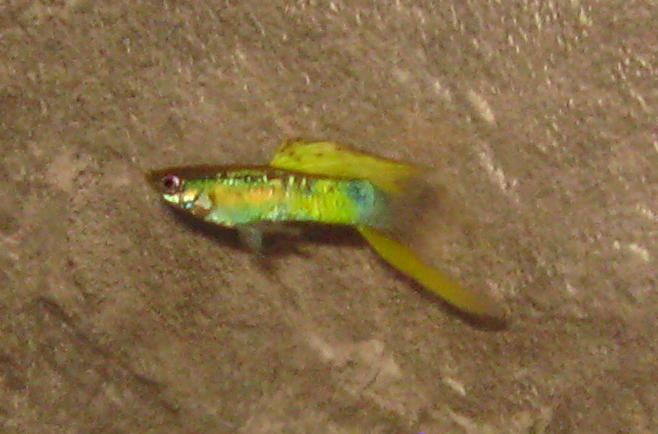
Panda Male (XYMw PkPk


Introduction:  As I don’t breed purely by scientific method, nor solely for show and consider myself a stock breeder first and foremost, I’ve been searching for a term or phase to encompass this amalgamation of three distinct schools of thought.  One that describes what guppy breeding means to me and my approach towards it.  Recently, long time Betta breeder and judge, now fellow Swordtail  Guppy breeder, Prof. Leo Buss offered up the following in correspondence:  “Pursuing aesthetic goals in a scientifically informed fashion.”  As this is much more eloquently stated than my abilities allow for, that’s what it shall be.

It is generally accepted the basic Pink Moscow (Pk + Mw) or Panda phenotype arose in several locations to include Europe and Asia.  The late Japanese breeder Yoshiki Tsutsui is generally credited for the first documentation and stabilization into a recognizable strain, which he named “Panda.”  The following is not intended to be all encompassing, and will focus on color / pattern variants and not those involving finnage:  long fin variants.  It is based for the most part on personal experience and observations of other breeder’s results.  To a lesser degree incorporates prior publications, of which I found to be minimal.  My breeding experience and fascination with Panda’s goes back more than a decade.  In the world of delta guppies this hardy, fertile and long-lived phenotype often gets little more than a second glance.  Yet, for these same reasons it maintains a dedicated international following with guppy breeders who also enjoy active strains…

Breedings:  The first Panda strain I bred in MT was rumored to have been descended from Tsutsui stocks.  It had potential for very long dorsal extension, at least in the world of Panda’s, and periodically produced homozygous blau pink individuals.  In this mutation the dorsal was always clear.  The caudal expressed as clear narrow flag tails with bits of red and translucent blue bodies devoid of other color pigment.  For this reason I assumed it to be what is now commonly referred to as European Blau (Eb), which in my mind put some doubt on the strains origins.  This also suggests the basic Panda phenotype, at least in this strain, was epistatic to red.  Barring was only present in a portion of the males and always partially masked.  I did not attempt to verify if autosomal Z-bar (Ze) or sex-linked Tigrinus (Ti).  One of the few outcrosses I did with this strain involved a Purple Moscow Delta * Panda breeding.  The F1 were sib bred to produce a nice line of Panda with Purple Body Mutation (Pb) with a noticeable reduction of coloration in pectoral fins.

Two years ago I intended to obtain Panda’s and again use the homozygous pink (Pk) females joined to select Purple Moscow (Mw) males as foundation for a new strain.  By doing so would produce a Panda strain for both blue and purple peduncles.  But this would have to wait.  After obtaining, my current Panda strain initially demonstrated poor viability in females which necessitated an outcross.  Subsequent outcross with Panda males as sires seemed to confirm weakness in females.  With no available classes for North American show entry, interest and availability of Panda’s in North America has seriously decreased over the last decade. 

Strain Reconstruction
Generation1:  For initial outcross I set up a breeding group consisting of a grey Panda male with three existing sons to be bred with several Golden (gg), IFGA Bronze Delta, females obtained from breeder Rick Grigsby.  These females were utilized only for initial outcross to produce 1st generation F1 and discarded shortly thereafter.  All heterozygous Pk males in the F1 were discarded.  I’ll note that all F1 males were traditional dark shouldered Moscow Delta phenotype with a weak snakeskin pattern in the peduncle and dark variegated dorsal / caudal.
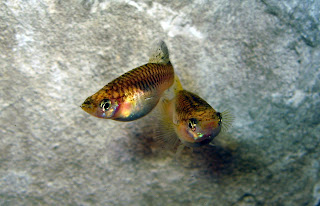
R. Grigsby Bronze Delta Females

Generation2:  Resulted from a BC1 backcross, again involving all four original P sires and a select group of 6 F1 females.  In this manner I could reinforce any retained X-link Moscow color traits and also produce 50% Panda.  It had to be considered such a route could reinforce any remaining detrimental X-linked fertility traits I was trying to eliminate.  Heterozygous Pk males and females in the BC1 were discarded.  Only those males and females which expressed homozygous Pk in conjunction with Mw were retained.  Staring with this generation females were selected for increased green iridescence on the topline.

Generation3:  Production of the 3rd generation left me with a bit of a dilemma.  The 2nd generation BC1 in theory had recombined the original X’s in 50% of females and 100% of males also possessed the same X.  However, with continued backcross it was possible to lose the autosomal recessive gg.  Not only did I wish to retain this trait into the 3rd generation, but wished it to express.  For this reason I sib bred the 2nd generation BC1 offspring, and hoped 1st generation simple outcrossed had resolved issues with females.

Several 2nd generation BC1 males were individually set up with 2-3 sibling females each.  Drops were collected from each breeding group to identify which, if any, males and females were heterozygous for gg by production of Golden offspring.  After one male was identified, all other breeding groups and their offspring were discarded.  This decision based on his superior phenotype and as a means to conserve space

2nd Generation Heterozygous Golden Panda Male (XYMw PkPk gg)

From this sole breeding group it has been possible to produce strong, hardy and viable Panda with the addition of an autosomal Golden Pink Moscow Variant.  Collection of fry from this group is ongoing to identify any sons which exhibit superior phenotype to their sire.  In effect, an intentional genetic bottleneck for specific intent.

Generation4:   To date most members of this generation result from ((Golden Pink Moscow) * (Golden Pink Moscow)) breedings.  As expected all are gg and will likely be maintained as a distinct line.  Golden guppies are known for less density of coloration in the body and finnage.  Pk still has the same effect on melanophores on scale edge, only now more exaggerated not only in body, but especially finnage combined with gg.  Many grey Panda express partial barring that is near completely masked with maturity.  So far this barring is present in 100% of gg males, but was not expressed by their 2nd generation sire in the photo above .  This would seem to suggest either a X-linked Tigrinus (Ti) or an autosomal dominant version of Zebrinus (Ze).  As males of this phenotype near maturity the barring is still completely visible.  The peduncle has darkened heavily, but retains very iridescent features.

Golden Panda Females (XX PkPk gggg)

                               
Immature Golden Panda Males (XYMw PkPk gggg)
Additional non-Pk females containing genetics for Pb, blond (bb) and albino (aa) have been introduced for production of other Panda variants.  Sib breedings of F1 offspring have commenced.  In each case of outcross utilizing Panda males the expressed Moscow Phenotype in F1 hybrids remains surprisingly consistent:  1. Blue shoulders, 2. Silver snake-skin like peduncle and 3. VAR finnage.  This being nearly identical to the earliest reported Moscow half body snakeskin strains.  Is this indicative of the initial Moscow inputs of the strain or does it include those from introduced females?  I believe it does reveal the three traits to be in “complex” as little if any deviation is visible.  The most visible stems from introduction of yellow color pigment via my Vienna LS females to produce blue-green shoulders, yellow snake pattern and green VAR finnage.   

F1 Hybrid (Panda * Albino Vienna LS)

Discussion:  Pink Moscow as they better known in Europe, are a composite phenotype created by the blending of predominantly Y-linked Moscow (Mw) and homozygous autosomal Pink (Pk) traits.  In a basic grey body form are notated as:  XYMw PkPk  and commonly referred to as Panda’s.  A quick search of images and breeder webpages on the internet will reveal subtle variations between individuals, both male and female in grey form. It will also show variants with additional autosomes.  Are these examples all reflective of the original phenotype documented in Tsutsui’s Panda strain, and for that matter what constitutes a strain?

Generally, a named strain is a very line bred or long-term bred to produce recognizable phenotype.  Individual breeder(s) do so in hopes of a strain which breeds true to itself with a high degree of replication.  It takes line breeding to reinforce many of the subtle traits a strain is known for.  Those that go beyond simple sex linkage or autosomal inheritance resulting in phenotypes from combination and complex.  A hybrid phenotype is just that, it is not a strain.  The IFGA and other show guppy organizations tend to get around this quandary in a rather simple fashion.  They view things almost exclusively based on categorization by visible phenotype as expressed at the moment, and not strain names.  This works rather well for judging purposes, in most situations, and avoids a lot of the pitfalls they may result from differences of opinion on genetics.

Some strains are highly fixed to a single phenotype with little variation and many breeders adhere to this in both practice and philosophy.  Others may be recognized for autosomal variations such as grey, blond (IFGA gold), golden (IFGA bronze), or albino.  They may also reflect variations such as solid or variegated finnage as in snakeskins. Or even short fin or long fin variants.  The list goes on.  Again, many breeders adhere to this more “fluid” definition of a strain in both practice and philosophy, while others do not.  I fall into this latter group of breeders preferring very complex, yet fluid strains that express a host of variation.  The only true precursor is you are breeding for intent.

When breeder intent is to duplicate the original definition and you continue breeding along criteria that will further refine the results to meet that original definition, you are breeding towards a named strain.  To further argue that source genetics must be documented as descending from the original breeder is counterproductive.  Simply do so if you feel a need.  Most guppy phenotypes are readily reconstructed from unrelated sources.  What is important is your understanding of them.  Each of the variants presented either in discussion and/or photographs in this article are genetically Pink Moscow’s.  So to answer the initial question:  Are these examples all reflective of the original phenotype documented in Tsutsui’s Panda strain?  No…  

As a breeder you have the discretion to put your own individual signature on a strain through modification.   I find it best to acknowledge any deviation and resulting variants.  In example, my primary interest in guppy breeding has always been and will likely always be Swordtails.  In specific Vienna Emerald Lower Swordtails.  My strain is comprised of several lines composing many phenotypical traits that result from specific combinations of X, Y or even X & Y-link traits further influenced by several autosomal traits.  These traits may be standalone or they may be in linked complex.  I acknowledge they do not meet the original documented European definition of a Vienna Emerald, for this reason I refer to my swordtails as of “Vienna Type” and not “Vienna Emerald”.  In documenting I normally refer to specific variants by genetic name and notation.  Example:  Asian Blau Vienna Lower Sword YLs SmIr X Ab.

3 month old Golden Pink Moscow Males (XYMw PkPk gggg)

As demonstrated in my recent breedings, with a little knowledge of guppy genetics and patience a breeder can often easily reconstruct phenotypes, including the Panda from a single male in as little as two generations.  The inheritance of the Pink trait is no different from many autosomal recessive alleles.  Either sex is capable of passing Pk in unexpressed heterozygous formStill it is best to qualify use of the term “unexpressed”, as some visible modifications to melanophores in heterozygotes are visible in both Pk and gg.  Visually Pk shares several similarities with Golden (gg), also known as IFGA Bronze, in relation to melanophores. 

Homozygous Pink Moscow fry, regardless of additional autosomes, are easily distinguished at birth by a highly visible float and eyes which seems to fade with age.  Panda are found to have either black or silver eyes at birth.  With the appearance of secondary coloration from Moscow traits over the eye socket dominant or flashing males take on a nearly pure black eye.  Careful examination of fry under handheld magnification reveals a dark region over the topline extending to and increasing in coverage over the cranial region and above the eyes.  This stems from enhanced manipulation of melanophores in these areas and to a lesser degree in the flanks above the abdominal cavity.  This continues to increase with age and will lesson perceived brightness in regions found at birth.

Grey Panda Females (XX PkPk)

Just the opposite seems to occur in the lower peduncle, with an increasing reduction from below the dorsal base towards the caudal base.   Further revealing an “opaqueness” of flesh that is found over the entire body in Pk homozygotes.   Again, a similar phenotype found in homozygotes for both Pk and gg phenotypes.  

Without the addition of the Half Black genes Nigrocaudatus (Ni or NiII)  to Pk it is hard to see the gene pink as “color pink”, as it more resembles “white”.  Pink guppies are considered capable of expressing all colors typically found in guppies except red, as a result of the Pk gene.  It should be noted the existence of several Pingu strains w/visible red Mw in the shoulders.  This and the ability of Panda to express Pb in the peduncle  and Homozygous Eb Pink Moscow to express limited red in the peduncle casts some doubt on the theory of homozygous pink completely suppressing expression of red pigment via epistasis.  When Pink is found in combination with the Ni or NiII red color pigment in finnage is modified to a pale orange.  Fixed strains in this combination are often referred to as Pingu.  In some instances it is difficult to tell the difference between this modified orange and unmodified yellow pigment.  Red pigment may result in clear or light dorsals, while yellow can enhance.   

There are nearly as many phenotypical variations in Pk females as males.  This stems from their individual genetic background and how much effort has been put into re-enforcing original X-link Moscow traits of foundation sires.  After outcross, initial homozygous Pk females are often lighter than those from line bred strains.  A “pink” peduncle is still visible in either case, although the body may appear little different from a heavily reticulated non-Pk grey bodied female.  Even in these instances they will change with age as lighter “fleshy opaqueness” is still present, albeit reduced in expression.  Heterozygous gg females express more intense reticulation compared to regular siblings. Homozygous Pk females with a single dose of gg often express a visible difference in scale pattern from simple homozygous Pk siblings.

Grey Bodied Heterozygous Golden Pink Panda Female (XX PkPk gg)

Panda are not a round tail guppy in a traditional sense as a result of genotype.  Caudal shape is a result of homozygous Pink modification through suppression of Pigmentierte Caudalis (Cp), but may be further enhanced  if X &/or Y-link round tail (Rndt) genetics are present.  Most breeders find it wise to select for the darkest caudal and dorsal with clean round shape to avoid either exaggerated clear trailing edges, clear patches, or irregular shape.   

Homozygous Pk Vienna Swordtails -  Photo Courtesy of Björn Lundmark

It is routinely assumed by many breeders that homozygous Pk in conjunction with Mw modifies parental strain finnage (dorsal and caudal).  This assumption is twofold in error; 1.  Extension genetics are not removed, just suppressed to varying degrees by epistasis. 2.  Homozygous Pk in itself is capable of suppressing extension genetics in several strains.  In example above are Homozygous Pk Vienna Swordtails bred by Björn Lundmark.

In recent years I have noted several autosomal homozygotes routinely result in body modifications.   In well-bred Panda strains both males and females exhibit a type of “chunkiness”.  Being defined as; more tightly coupled in both the abdomen and peduncle than either parental stock.  Overall structure of the head and gill plates are also more “rounded” than either parental strain.  Though expression may be enhanced from combination of Mw + PkPk, there is a similar effect found in homozygous AbAb fish.  An autosomal recessive Zebrinus (Ze) in homozygous form has had just the opposite effect in my Vienna LS;  1.  Delaying maturity to produce a “long lanky” body.  2.  Diminishing dominant epistatic effect of Y-link LS over X-link DS to reveal “topspikes.”

Panda Male with X-link yellow pigment (XYYMw PkPk) showing clear edge on caudal

One of the more noticeable traits in Panda is prevalence for clear trailing edge on caudals.  As dorsals commonly exhibit less of this modification it would be easy to believe the effects of pink are limited to the body and caudal coloration.  Or are they?  Panda caudal and dorsal color is biased towards blue iridophore and melanophore modification.  While the dorsal in a Panda often looks very dark and solid, outcross often reveals Variegation (VAR) to be present.  This is a noticeable deviation from expressions held in common with gg.  Homozygous pink is likely suppressing expression of VAR, while it is commonly expressed in gg.   Depending upon mood dorsals can be very lightly colored in Pink Moscow.  This may result if red pigment is suppressed by Pink or if color is predominantly based on blue iridophores.  Incorporating an X-link for yellow fin coloration can override some of these issues.   

Without any additional color pigment and reduced melanophores Blond Panda often express clear dorsals and are rather flat in body color.  Blond Glass Belly Panda with reduced iridophores even further exacerbate this expression.  While Albino Panda can be similar to blonds in expression, there are marked differences in both iridophore and melanophore expression.  Not so “washed out” comes to mind.  Male and female grey Glass Belly Panda, with higher retention of melanophores, clearly show reduction of iridophores in both the body and finnage.  

Glass Belly Panda (XYMw PkPk GbGb ) courtesy of P Shaddock

The overall body color on Panda is a result of blue iridophores in combination with homozygous pink.  It is easily modified to purple with the addition of Pb or green with the addition of yellow pigment.  While a Panda may seem black, closer inspection reveals standalone blue is still visible in select areas on the skull, shoulders, peduncle and caudal base.   Most breeders select for a solid black coverage with attention to degree of iridescence.  A flatter black Panda has been achieved by European breeders, and appears periodically in my stocks, similar to a Black Moscow Delta counterpart.  From available evidence it appears this was accomplished with increased silver iridophores at the expense of blue.

Grey Panda with pronounced silver iridophores

All finnage on a basic Grey Pink Moscow expresses nearly solid black, regardless of additional pigment, though iridophores can bleed heavily into the caudal base.  This includes; dorsal, caudal, pectoral, pelvic, and anal.  Homozygous Pk results in intensified collection of black melanophores in certain regions of the body and fins.  At first glance the addition of homozygous gg to homozygous Pk appears to reduce this effect; Magnification reveals it to be further amplification of collected melanophores in limited regions.

5 month old Golden Pink Moscow Males (XYMw PkPk gggg)

One of the more genetically intriguing variants combines both Pingu and Panda phenotypes:  (XNi YMw PkPk).  The anterior still resembles Panda.  There is deviation from Panda phenotype in all finnage.  Not just limited to the typical lighter colored Pingu caudal and dorsal.  It includes the pectoral, anal and ventral fins, which have lost all or most black coloration as the result of Ni.  (Note:  Reasons will be expanded upon further down.)

Pingu Panda (XNi YMw PkPk) courtesy of D Czajkowski

The posterior is classic Pingu peduncle and finnage, though pink stops just short of early versions which extended to dorsal base.  Many Pingu today are similar and exhibit black on the topline in front of the dorsal with a Mw shoulder, likely from Moscow Delta foundation sires.  Original Pingu had two distinct shoulder types.  One was darker in shoulder and topline, but did not possess Mw genotype.  The second was an “Old Fashioned” shoulder pattern in which a red stripe was suppressed via epistatic effect of Pk.  Leaving for the most part only white leucophores or silver iridophores visible (see photo below.) In both cases Pk often extended into the abdomen.

Ca. 1985 Pingu (XNi Y PkPk).  Descendants of David Liebman stocks
 maintained by late Don Sauers and myself


Pink Moscow Variant coloration at the juncture of peduncle  / caudal (not inclusive of all potential)


Conclusions:  Pink Moscow are routinely bred and shown in both Asia and Europe by a dedicated following.     A lack of defined class in North America has restricted both interest and development. In all locations a loose definition of what actually comprises a Panda Guppy has allowed for a diversity of type to arise from a singular phenotype.

Based on the ease of creation it would be safe to ascertain that few if any Pink Moscow found today actually descend from either initial European or Asian (Y. Tsutsui) stocks.  The diversity of phenotype in today’s Panda strains not only is indicative of a variation in foundation Moscow genetics utilized for Y-link traits, but also female genotype.

Many guppy breeders view the Panda phenotype as a simple combination of Moscow blue and homozygous Pink.  This fails to encompass:

1.      Additional autosomes breeders can incorporate to create complex phenotypes very diverse from original descriptions,
2.     Neglects the line breeding needed for refinement into individual Strains,
3.      The diversity of genetic sources used in foundation lines,
4.      Degrees of intensity based on mood of the individual fish,
5.      A non-demanding physical structure.

Basic Panda are fairly similar in genotype.  After initial crossing of parental stock, differences can be readily visible for several generations depending upon breeder selection, compounded by loss or retention of any X-link Moscow traits.  There is clear evidence of manipulation of black melanophores at birth in Pink Moscow’s. 

As with most guppy strains a clear progression of secondary color / pattern development commences at onset of sexual maturity.  Increased iridophores to reveal silver / blue and expression of barring; followed by appearance of color pigment; and finally, in contrast to cellular layering, further enhancement of black melanophores to partially overshadow iridophores.  Suggesting some black in Panda’s is ectopic in nature and not limited to lower cellular levels.

Panda Moscow Lower Sword (LS + Mw + Pk + Ssb),
Photo courtesy of breeder Olof “Ollie” Boberg

In all but a few Pink Moscow strains coloration is highly motile in nature as a result of Mw gene(s) interaction between black melanophores in conjunction with structural iridophores & color pigment.  When possible it is wise to delay selection of your breeders to identify those with best density / intensity of coverage in body and fins.  As a result of foundation Moscow Blue (blue iridophore) genotype, descendants of Tsutsui Panda stocks were very dark colored in the peduncle.  There may have been a blau component (Eb or Ab) which was not documented.  Today, depending upon breeding Panda are also found in both green and purple body mutation (Pb).  This could stem from use of Pb females or Purple Moscow males as parental stock instead of Blue Moscow.  

Observation reveals to breeders how zones of regulation are allowing for the varied appearance in today’s Panda.  Easily evident are increased melanophores in topline and finnage, iridophore / pigment modifications anterior and posterior.  Less noticeable at first glance are zonal effects on patterns such as Zebrinus / Tigrinus and Snakeskin.  Normally found over the entire peduncle, like many other strains, they can be restricted to either upper or lower quadrants in Pink Moscow.  In the males below barring is present in both upper and lower, while snakeskin is restricted to the upper.  I have not witnessed the latter in inverse, snake in the lower, as is possible with other traits such as Saddleback (Ht).

                     
(Left photo) Panda Moscow w/barring in upper
 & lower peduncle. Snakeskin in the upper peduncle. 

(Right photo) Blond Vienna LS w/barring
 in upper peduncle quadrant 


Homozygous Pink has often been characterized as having its greatest effect on iridophores.  However, this is not necessarily the case.  Pk exerts a far reaching impact on all levels of cellular structure in regards to color and pattern.  Most breeders acknowledge guppy color cell layering to consist of:  A lower layer of melanophores (black); a middle layer of leucophores/iridophores (minimally being blue / silver / white); a top layer of zantho/erythrophores (yellow / red).

In Goodrich, et al., (1944) regulation of phenotypic expression of melanophores by autosomals Blond and Golden are studied.  He describes Wild-type as “in some respects intermediate between the Golden and Blond.”  His  research divulges several types of melanophores:  1.  Dendritic (on the scales), 2.  Corolla and Punctate (on the body).  For the most part they are present prebirth, at birth or shortly after birth.  While Wild-type and gg guppies have the largest dendritic melanophores, bb has the smallest. Yet wild-type and bb have nearly the same amount (concentration) per square mm of tissue sample.  

Goodrich, et al., (1944)

In Nayudu, et al., (1979 No. 2) melanophores in Wild-type and three other sex-linked traits are studied.  Of particular interest in relation to Pk are her results for Half Black (NiII).  She defines them as “mutant”, being ectopic and larger than normal.  The mutant melanophores of NiII, Flavus (Fla) and Cp are present in at least the posterior peduncle region, caudal / peduncle juncture and dorsal base.

Nayudu, et al., (1979 No. 2)


Autosomals blond and golden are both considered epistatic to black in homozygous form.  Not by directly affecting melanin synthesis, but by regulating melanophore size.  Blond has little or no effect on Half Black (NiII), which has been shown to consist of larger sex-linked mutant black melanophores.  In contrast autosomal Pink aggregates concentration of regular melanophores and suppresses mutant melanophores, based on Panda and Pingu phenotypes.  Thus, being in divergence from gg and bb, Pk appears to regulate in both instances…  


Pink Moscow Male – top  (XYMw PkPk)
 Golden Pink Moscow Male - center (XYMw PkPk gggg)
 Het. Golden Pink Moscow female  - bottom (XX PkPk gg)

I used to worry that this wonderful little phenotype would disappear from the scene like so many others have in the past.  Yet, the simplicity of genotype allows for quick reconstruction from many sources.  While the more obvious phenotypes have already been produced in multiple locals, it’s hard to tell what may be presented by breeders in the future.

On a last note, it should be mentioned that Panda Moscow are a notoriously slow growing, but long lived strain.  After a quick growth spurt the first month it takes considerable time to reach mature size and coloration.  If you have an exceptional bodied male in with a group of siblings that just never seems to color up to expectations, remove him to another setting.  Often this is all it takes to reveal the full potential as a result of the motile nature of color found in Pink Moscow.

The final words in this article belong not to myself, but the individual who bred, named and documented the Panda strain.  In his words:  My answer may be abstract Japanese way... I first draw the exact image in my mind the guppy I want to create, then print it in my mind. Then keep thinking of the image everyday when I feed my fish. After a while, fish start to lead me on what to do and my eyes become more keen, so often find the guppies I need from my fishroom without adopting guppies from somewhere else.  This is what I call "Guppy Alchemy." ~ Yoshiki Tsutsui ca. 2005


References:
1.      Robert Gall, (2005), Guppy Labs e-Bulletin, Base Body Color Pink, Volume 7, (July 2005), http://guppylabs.info/july2005/robert.htm (no longer active site - wayback machine capture 2012)
2.      Telephone Interview by Tomoko Young, (2005), A convsersation with Yoskiki Tsutsui, Guppy Labs e-Bulletin, Volume 5, (January 2005), http://guppylabs.info/january2005/YoshikiTsutsui.htm (no longer active - wayback machine capture 2012)
3.      Shaddock, Phillip (2010).  Guppy Color Strains.  Printed in Canada, Pocket Cine Books. [General Reference; Moscows pgs.:  15-36 / Pinks and Pingus pgs.:  113-120]
4.      Heike Savelsbergh, Guppyheike (webpage),  Moskauer Rundschwanz, http://www.guppyheike.de/guppys/pink-mosi-rs/  (10.31.12 active)
5.      Winge, O., Genetic Laboratory of the Royal Veterinary and Agricultural College, Copenhaen  (1927).  "THE LOCATION OF EIGTHEEN GENES IN LEBISTES RETICULATUS" [gene tables and descriptions]
6.      Petrescu-Mag I. V., et al., (2007(, Interallelic interaction between the autosomal Blond and the sex-linked Nigrocaudatus gene in the guppy (Poecilia reticulata). AIR 2(1).
7.      Kirpichnikov, V. translated by G.G. Gause., 1981, Genetic Bases of Fish Selection.  Berlin / NY, Springer Verlag (1981) [gene tables and descriptions]
8.      Shaddock P.,(2008), Blond: a regulatory gene in the guppy (Poecilia reticulata Peters 1859). AACL Bioflux.  1(2):161-164.  Printed version: ISSN 1844-8143
9.      Nayudu P.L., et al., (1979 No. 1), Genetic Studies of Melanic Color Patterns and Atypical Sex Determination in the Guppy, Poecilia reticulata, Copeia 1979, pp. 230-231,
10.  Nayudu P.L., et al., (1979 No. 2), Cytological Aspects and Differential Response to Melatonin of Melanophore Based Color Mutants in the Guppy, Poecilia reticulata, Copeia 1979, pp. 240-242.
11.  Goodrich H. B., et al., (1944), The cellular expression and genetics of two new genes in Lebistes reticulatus. Genetics 29(6):584–592.


~~~~~~~~~~~~~~~~~~~~~~~~~~~~~~~~~~~~~~~~~~~~~~


Breeders of many fish species are intent on maintenance and preservation of what already exists.  Guppies present a unique set of challenges if only by diversity of genotype.  As breeders it is easy to believe we can add to the equation while forcing them into a specific mold.     An old adage in the pedigree livestock world states, “You start with a 100% package and you end with a 100% package.”

 All we can do as breeders is re-shuffle the deck for gains in one area and corresponding losses in another.  This is a constant when breeding any species.  There is no way around it.  Seek a balance in your efforts in conjunction with your goals to reveal what Mother Nature will allow within your particular environment…

~~~~~~~~~~~~~~~~~~~~~~~~~~~~~


Click on blog photos to enlarge

Click on blog photos to enlarge