BREEDING RACK SYSTEMS; Automation for Water Change
& The Use of Single Point Filtration
© Alan S. Bias
Permission granted
for nonprofit reproduction or duplication of photos and text with proper credit
for learning purposes only.
August 26, 2013
© Alan S. Bias
Permission granted
for nonprofit reproduction or duplication of photos and text with proper credit
for learning purposes only.
Discussion:
As a Guppy breeder
over the last 30 years I have been fortunate to have had 6 fishrooms. Five in locations within my residences and
one in the backroom of a large retail aquarium / fish store. Each
incarnation was within the confines of a dedicated room solely for the purpose
of breeding and raising guppies. While
it is common in Europe for breeders to heat and cover individual tanks in both dedicated
fish rooms and standalone breeding racks, this is often not the standard practice
in North America.
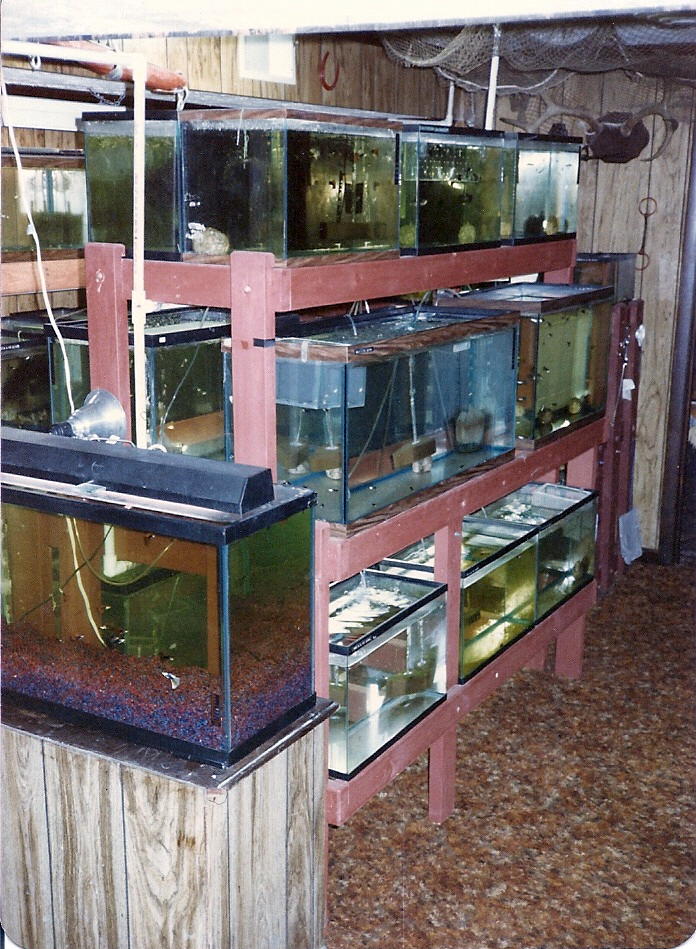 |
| Ca. 1984 manual breeding racks |
Historically, In the US and Canada, an entire room is heated
in winter to maintain a median rack temperature of 70-80*. Though in practice the usually varies from
70-72* on lower rack and 78-80* on upper tiers.
For much of the year this requires a constantly running de-humidifier
preset to a desired level. Unlike de-humidifiers
found several decades ago, modern counterparts generate massive amounts of heat
during the process of removing excess moisture from the air. During spring, winter and fall this is not a
bad thing, as it helps maintain fishroom temperature at a range long viewed as compatible
with breeding guppies.
In Montana I found the use of modern de-humidifiers not so
much of an issue in comparison to usage in the lowlands of Virginia or even the
highlands of West Virginia. Out West it
was not uncommon for humidity levels to range from 25–50% during the year. Summer averages dropping as low as 8-10% and
in winter 50-60%. Here in the East
winter levels rarely drop below 50-60* and in summer can range in the 80-90%
range. So any excessive heat generation
during the process of de-humidification can compound an already uncomfortable
environment. My favorite practice in
both situations tends to be a combination of running fans, leaving the doors
slightly ajar to vent excess humidity and seasonal use of de-humidifiers.
Herein, is the dilemma.
For many, in this modern age both the expense and feasibility of large
dedicated fishrooms is quickly becoming a thing of the past. Even when financial resources are available,
limitations of physical location and water quality may in itself prohibit
creation and maintenance of a dedicated fishroom. Yet, based on worldwide communications,
general interest in breeding guppies is as strong as or stronger than bygone levels. Is there a practical alternative? I think, yes…
 |
| Automated Breeding Rack Systems with single point filtration (courtesy of Derrick Tan) |
For over a decade I have been following the self-contained
“Asian Style Breeding Racks” with not only intense interest, but
curiosity. Are they a viable option for
the average Guppy Breeder? In most instances they are designed for both automated water exchange and fitted with recirculating sump filters (Single Point Filtration). In this part
of the world where success and value of both livestock and livestock breeding
programs are often gauged on the attitude of “Bigger Is Better”, they have met
with limited interest. Commonly faulted
for both small compartment sizes and recirculated water. A prevailing belief that large tank sizes are
needed to raise large guppies and recycled water is a precursor to large scale
disease outbreak. Many guppy breeders
believing that water should not be exchanged between tanks as a means of
disease prevention, accepting a need to isolate tanks as mini eco-systems.
Having both an intense interest in the study of population
genetics and raising guppies in natural systems tells me this should not be the
case. Mother Nature seeks moderate
stocking ratios in populations via allowable food resources, predation, natural
lifespan and disease. She also allows
for a means to recycle water in a natural setting between pools via evaporation
and replacement through percolation or rainfall in the guppies’ natural range. Aquatic
environments often require minimal movement to purify over rock and silt, a
natural filter bed. While populations
between pools may suffer from genetic isolation, via natural barriers such as
waterfalls and remnant pools, they rarely suffer from total environmental
isolation. Commonly accepted practice states that most
diseases result secondarily to poor water conditions. Why should it not be possible within a
well-balanced breeding program to duplicate a natural system if components are
kept in balance?
Research of others and my personal experience finds fault in
poor water conditions, breeding practices, compounded by stocking levels, lack
of quarantine and acclimation. It is
rare for entire populations of guppies raised outdoors in ponds at moderate
stocking ratios to become sick. Even
rarer for wild guppies in riverine systems to suffer from large scale virulent disease
outbreaks, that go beyond isolated bacterial infections of individual specimens
in pools. Ever wonder why early diseases,
such as “Ick”, a common curse found in early guppy stocks were easy to treat
after identification? Yet seldom seen
today? They came with the wild stocks. Diseases from initial wild populations tended
to focus on the weakened individuals and not populations as a whole. When a particular disease is removed from the
equation, it is often replaced by something worse under poor selection or
husbandry practices. A scenario that is far too common in the
evolution of modern urban mankind.
Over the last century non-traditional selection criteria, forced feeding for
accelerated growth, overcrowding for production have fostered diseases which
now attack our captive guppy populations as a whole. A nearly identical parallel has been found in
all modern commercial livestock breeding across species. Selection based on confinement and accelerated
growth has resulted in breeds with shortened lifespans and chemical reliance. Additionally, guppy breeding often lacks a consistency
in quarantine protocols & procedure found in large mammal livestock
breeding. It is not uncommon for imported
animals to be quarantined for several years, if not several generations before
being released into a general population.
All in toll, we have allowed for introduction, expansion, and likely
evolution of both bacterial and viral diseases within captive guppy stocks at a
population level. It would not be
surprising to find within guppy populations the existence of a third class of
infectious agent, additional to viruses and bacteria, such as prion’s found in
large animal ruminants and humans.
System Design / Implementation:
 |
| Breeding Rack fully automated for water change and single point filtration |
As stated my personal interest in considering the use of a Breeding
Rack System is based on finding an
alternative to a large scale dedicated fishroom. The two primary reasons being stability and
ability; stability in maintaining a breeding program & ability to continue
a breeding program. I have been breeding
and raising guppies in some form or fashion nearly nonstop since 8 years of
age. With gaps only occurring when it
was not practical to setup and maintain a fishroom. Not for lack of space, but a lack of suitable
space to utilize as a fishroom; an existing basement room, garage, extra
storage room, spare bathroom. The
limited footprint of a breeding rack seems to offer a lot of possibilities in
any setting.
It took quite a bit of consideration to formulate just what
my needs would be, and nearly as much effort to stick with them during design
and construction. In short I sought:
·
Portability of tanks and racks
·
Utilization of compatible components
·
Minimum of 50 compartments
·
Ability to heat tanks without heating a room
·
Minimal lighting
·
Excellent water quality
·
Automated water change
·
A Maximum tank / rack height of 80”
·
Compartments size between 5 and 8 gallons
·
Drilled at the back of each compartment
·
Thick gauge glass for longevity and transport
·
Frames on top and bottom for transport
Most of the Breeding Rack Systems I found online or those sent
by fellow breeders utilize 4-5 rows of individual tanks without frames built to
specification for available commercially produced racks. I chose to do the opposite and build racks to
fit my tanks. Thus, the first step would be design
considerations for the tanks themselves.
From past experience I already realized, that while not cheaper to
construct, large compartmentalized tanks with tops would not only be easier to heat, but also better retain heat vs.
multiple small stand-alone tanks in several sizes. While glass is not a good insulator, thicker is better.
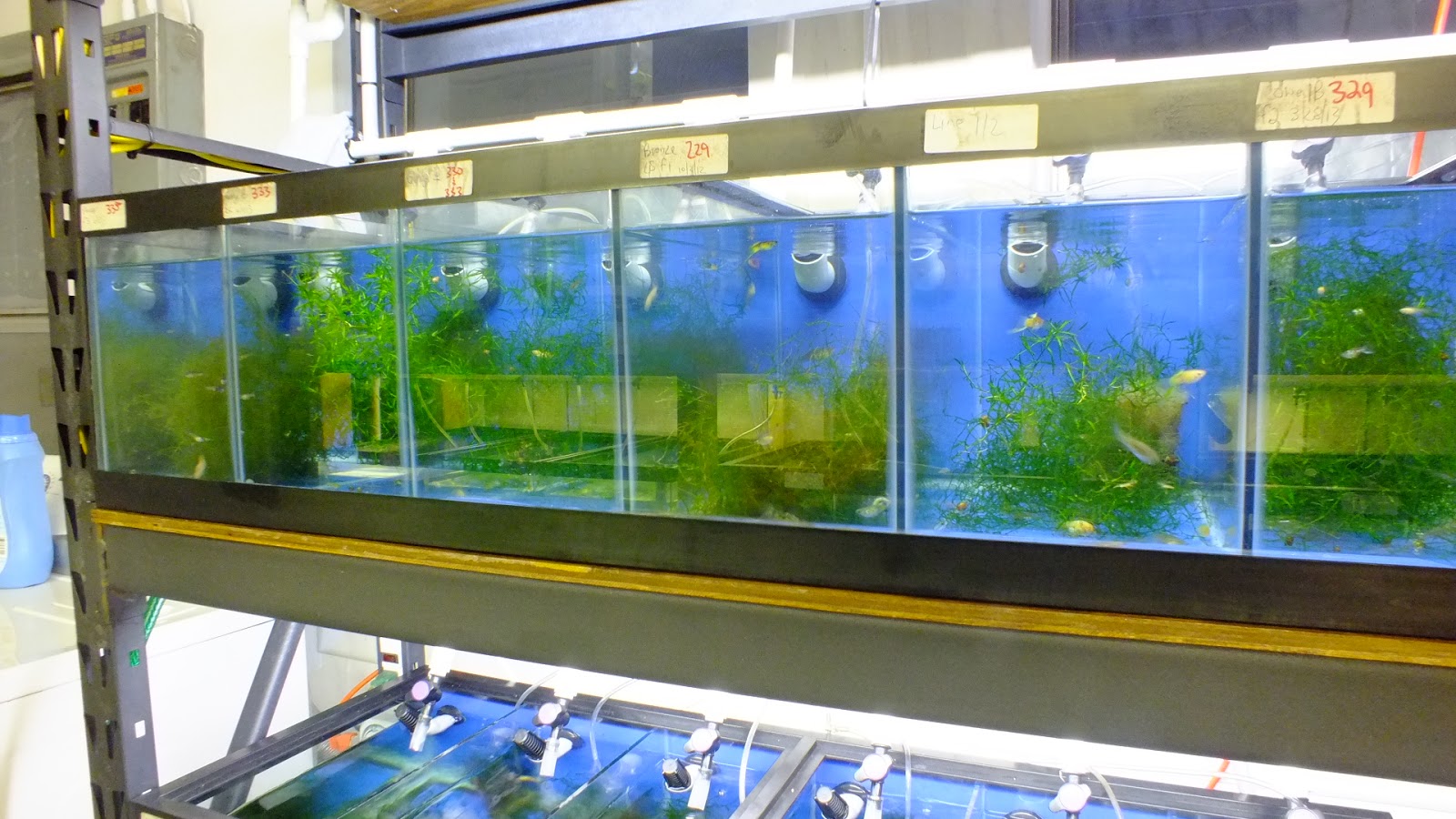 |
| Below water view automated compartmentalized tank |
After calculating dimensions, volume and weight I settled on
the following. A 48” * 18” * 12” (L*W*H) tank of 44 Gallons
(174.6 liters) in two variations. These
dimensions would allow for use of a standard set of frames on the top and bottom of each tank without
need for cutting. Frames are a must in
my mind for safe transport of large glass tanks.
 |
| Above water view automated compartmentalized tank |
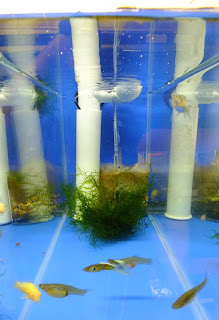 |
| View of 6 * 18 *13" compartment |
 |
| View of 8 * 18 *13" compartment |
To conserve heat and reduce humidity each tank has two 24”
hinged glass tops. This will allow for a
minimal heat source in the form of two small submersible heaters in the center
compartments of each tank 48” tank. A
heater in sump filtration will serve to supplement not only the sump but any
recirculating water in transit through piping.
Open tanks in themselves are not the primary source of humidity in a
heated self-contained fishroom. The majority
of excess humidity results from water displacement via bubbling filtration in
conjunction with heat.
Wishing for a more professional look than my skills allowed,
construction of the tanks & tops was outsourced to Glasscages.com located
in Dickson, TN. Construction was
completed in a timely manner to specifications with no issue. My wife and I met the tractor trailer on a
winter night alongside Interstate 81 in Lexington, VA. All six tanks fit into the bed of my pickup
truck with room for several more.
 |
| Bulkheads and drainpipe fittings |
After researching bulkhead costs and that of PVC pipe and
fittings I decided that ¾” offered the most efficient choice of options in
regards to water flow. It also seemed
more prudent to use “slip” on both inlet and outlet, instead of “threaded”. Slip on inlet for obvious later modifications
that may come about and slip on outlet so fixtures could be hard glued to avoid
leaks. Not so much from every day use, but
caused during transportation. Instead of
rigid PVC for drain pipe I went with plastic fittings and vinyl tubing to allow
from some “movement” during relocation. Remember, my primary goal is portability. This
also allows for a quick disconnect at the end of each tank for ease of removal.
 |
| Riser Tube & Bulkhead assembly |
Each compartment is serviced by a single ¾” bulkhead to keep
both the cost of drilling and fittings to a minimum. This is accomplished through a single “master
valve” to which all water flows that
controls water direction to filtration or waste. To allow for circulation &/or removal of
water from both the surface and bottom of each tank I designed a Do It Yourself
(DIY) riser tube. It incorporates an
intake strainer on the surface and a sleeve on the bottom. With only a single bulkhead in each tank this
serves to add redundancy in case a drain becomes plugged during operation.
 |
| Riser Tube assembly |
Being very hands on I find that I have been just as likely to hang my water hose and manually run water to each tank, as use the quick connects I installed to fill each row in
volume. Regardless of drainage design
there will always be a continuing need to siphon from the bottom of your
tanks. Though with a well designed system, at a much reduced volume
based on feeding schedule and age of fish.
Lighting I kept simple by selecting 48” Lithonia T-8 low
profile fluorescent strips. They are
very small and lightweight as compared to traditional T-11. Monetarily, both the fixture and bulbs are
still much more economical than modern LED lighting. In conjunction with 48” inch tanks this would
allow for even distribution of light to all tanks. A wide choice of bulb types is offered in 48”
for those so inclined.
 |
| T-8 Low Profile fluorescent fixture |
 |
| Retrofitted Wooden Breeding Rack automated only for water change |
A pedigree breeding program is often a direct reflection of
its environment in the eyes of those visiting your farm and seeking your
genetics. Normally my preference is wood
stands with a good coat of stain and polyurethane. Not only does this help protect and preserve
the stand for many years, it allows for ease of cleaning. An unfinished stand is about like putting on
your best suit and not polishing your shoes.
It takes very little extra effort and cost to finish a stand. Metal stands are very rigid, subject to rust
without rubber coating, and leveling issues with flaws in floors. However, just the opposite is true of a finished
wooden stand as they are easily leveled and very forgiving when properly
constructed.
 |
| Breeding Rack fully automated for water change and single point filtration |
While long-term I will build and utilize wooden racks, for
something a little different in the short-term I decided to try out a couple of
Edsal steel commercial shelving units. Each
being 60 inch wide * 66 inch high * 18 in deep . The total cost for each shipped from Home
Depo was less than 115.00 dollars. A
quick coating of rubberized spray paint in addition the black textured finish
should help with rust from both humidity and electrolysis. Currently, I have installed one rack as a test
with three tanks, while the other three tanks are being used on one of my
retrofitted existing wooden racks.
My permanent racks have all hardware and fittings securely nailed
and screwed in place. In my quest to
create a portable breeding system I did just the opposite. All is neatly held in place by trimmed nylon
tie straps, ready to clip apart and pack.
Initially, my thought was to utilize Grey Schedule 40 PVC
for aesthetic reasons. While the cost
for most individual components was similar to White Schedule 40 PVC, the cost
of one or two of the most utilized parts would nearly double the total
cost. In the end I just went with White
Schedule 40 PVC. Not so much for cost,
but ease of purchase. Just about any
piece you will need is found at a good local retailer. Grey PVC on the other hand I would have to
order living in a remote location. I
simply like to modify things on the fly far too often to wait for online
ordered parts. It can be painted if
desired. Rather than go into detail on
more common parts, let’s just say I ordered from two primary online sources;
Global Industrial and JEHMCO Aquatic Breeder Supplies. Article photos should give you enough detail
to go by.
 |
| Alita AL- 80 air pump (coustesy Dr. James Alderson) |
On a Central Air System a good air pump should be one you
never have to think about, much less service or repair. For the past 25 years I’ve relied on my
Rotron Blower to provide for 100 plus outlets.
It’s not quiet, but when kept in a crawl space or insulated box and
properly muffled, is not noticeable over bubbling of tanks. I will continue to use it until I relocate
and then install two newly purchased Alita AL- 80 air pumps. When you compare cost, output, noise levels
and reliability, they are hard to beat.
 |
| DIY Sump Filtration |
On one rack I decided to test out fully automated water
change and single point filtration. As I would be
adding the metal rack, it made sense to run test with it. In addition to a single corner filter housed in
each tank, a sump filtration system is housed on a standalone rack adjoining
and connected to the primary rack with tanks.
A single high wattage Eheim heater is held in the sump. While the sump is on the bottom row, it is
raised 4-6 inches off the ground for heat retention in winter. The
middle row of the rack houses an additional unheated sump solely for water
replenishment from evaporation. This
comes about via a bottom drilled ¾” bulkhead and riser tube in the upper sump
and a float valve in the bottom. In turn
“the replenishment sump” will serve to house breeding Cori’s, Pleco’s or
Shrimp.
 |
| DIY Water replacement for Sump Filtration with UV Sterilizer behind on left |
While I am not sold on their effectiveness in guppy breeding, I decided to incorporate and test UV
sterilization on the system. Feeling it
a must for single point filtration where recirculation of water is needed. After much online research purchased a 15 Watt Aqua Ultraviolet Classic UVC in Black with 2-inch slip fittings. Not that I felt it was any better than
comparable models, but at least it is easier than most to incorporate into rack
plumbing, bypass when the need arises, and service when bulbs require or
fittings need replaced.
 |
| Standalone Rack for DIY single point filtration and de-humdifier |
Redundancy for catastrophic failure has been factored into
the entire system via a check valve above the bottom sump and it having the
ability to absorb the entire volume of all water contained in both piping and
reserve sump. The top tier of the rack
houses a de-humidifier that is plumbed into the waste water drain pipe. All water movement (replacement, circulation,
and waste) is controlled through a series of PVC valves. It is driven by a single Quiet One 6000
water pump rated at 1506 GPH @ 0’ head.
This translated roughly to over 1000 GPH combined rack flow to all tanks
@ 5’ head.
 |
| Quiet One 6000 water pump in DIY sump |
New water is added via a “quick attach” and piped from heated
aged water in a 65 gallon barrel. It
utilizes the same piping as does the sump filtration. For water input to each tank I purchased ½” barb
x ½” male NPT threaded fill valves to allow for more precise and adjustable
control. This, as I would be utilizing
multiple tank sizes on 3-4 levels of tanks and a single water pump. Open PVC elbows or irrigation style drip
values would not allow for such control.
While the entire water system is glued together, I included multiple
quick disconnects to allow for modification and transport.
 |
| Closeup of Water Fill Valves and Riser Tubes with Sleeves |
 |
| JEMCHO pre-built manifold |
One of the “luxuries” I allowed myself in this project was
the use of prebuilt manifolds on each tank vs. drilling PVC and tapping valves
myself. With such short overall length
in the rows the effort was not justified.
Simply run ¾ inch PVC to each row and tap in a manifold. When needed they are easily daisy chained
together with hose barb connectors into either vinyl tubing or PVC. As the PVC & fittings secure tight
enough, I never find need to glue my air system together. This allows for ease in modification and
transport.
Summary:
Now back to the initial hypothesis in this article. Is an Asian Style Breeding Rack System with
or without re-circulating filtration a viable option for Guppy Breeders? Yes, under certain well defined criteria
starting with an understanding and acceptance of “slow time”. Modern Guppy breeders are little different
from any livestock breeder. Yet they are
also vastly different. Until the last
century livestock breeding was on slow time and practiced on a
multi-generational level by family members who grew up on the farm and rarely
worked off the farm. A bull taking 5
years to mature and a heifer bred to calf at three years of age. Today the same bull is expected to be in
production by 2 years of age and heifers having first calves on the ground at
two years. Sound familiar? It should, there is little difference in
either commercial guppy or show guppy breeding programs.
The history of domestic guppy breeding is just over 100
years. Evolving in cities and towns with
breeders at best several generations removed from the farm. Most breeders are not only little aware of slow
time, but have had “fast time” imposed upon them most of their lives from the
rigors of urban life, the requirements
of a show cycle, computerization, and even the ability of the guppy to produce
several generations within a year. For
an automated recirculation system to work Guppy Breeders must adopt and adjust
to a traditional slow time livestock breeding regimen of our fore-fathers.
 |
| Rebuilt Fishroom August 2013 |
So, are self-contained automated Breeding Rack Systems with
or without re-circulating filtration a viable option for Guppy breeders? Yes.
Are there benefits to be derived from such systems vs. large scale
dedicated fishrooms for Guppy breeders?
Yes. Are there limitations to for
use of such systems for Guppy Breeders?
Yes.
The debate will likely be ongoing in regards to Breeding
Rack Systems that are fully automated for water change and those that
additionally incorporate single point filtration. When limited to just water change the
benefits are undeniable. Allowing for;
ease of multiple changes, variance in the percentage changed, and consistency
in the chemistry / temperature of water changed. However, the variables are just that, too
variable to make a blanket assertion either for or against in use with single
point filtration for modern guppy breeding.
Just as many breeders are successfully utilizing sump filtration systems
as those who have abandoned them. From
my perspective I think it safe to state they can work under specific
circumstances:
1.
Systems need to be smaller rather than larger as
in modern laboratory settings.
2.
Several stand-alone racks are better than one
larger of the same volume.
3.
Slower water turnover and sterilization in
filtration is likely paramount to success.
4.
Large systems with multiple UV sterilizers,
large sump filters and high volume water flow are a requiem for failure.
5.
Both compartment numbers and total Breeding Rack
population levels should be carefully considered to maintain healthy balances.
6.
Avoid introducing new members (via acquisition
or returns from shows) without stringent quarantine protocols.
In final I should make it clear that I am still not convinced single
point filtration is a viable long-term option for most guppy breeders
who are showing or exchanging fish on a regular basis. Breeding programs are often not kept
in balance. I make this statement based on two supportive criteria: 1. Published research in the
field of Population Genetics. 2. My personal approach of breeding domestic guppies
towards goals in favor of healthy populations over individuals. Overall the majority of modern guppies just do
not have a built in predisposition for health on a community level.
To see the pitfalls of recirculated water on domestic
guppies all one has to do is visit your local large commercial box pet store
with a single point recirculating system.
It is geared towards high volume turnover of stock at the expense of
quarantine. The first species to break
down are livebearers, and at the forefront are modern commercial domestic
guppies.
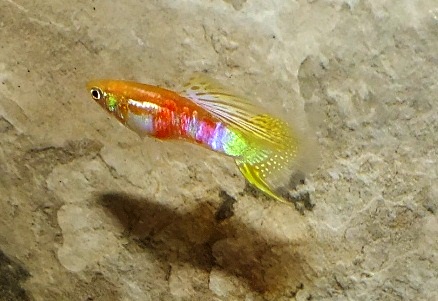 |
| Ginga Sulphureus Lower Sword |
Despite best attempts of host club members at shows, importing
disease back to your fish-room is inevitable and routine, when compounded by the stress our fish endure being on the road for a week to 10 days at a time. It is simply a given that comes with the hobby. Only strict quarantine measure,
treatment and continued isolation of returning show fish will eliminate or at
best alleviate the potential contamination of your stocks. On this basis returning show fish are best
not housed in a recirculating system.
To this end, I designed my Breeding Rack System with recirculating
sump filtration as an add-on component.
If at some point I deem it no longer feasible, it is easily removed,
parts recycled elsewhere, leaving only a Breeding Rack System with automated
water change.
Suppliers:
~~~~~~~~~~~~~~~~~~~~~~~~~~~~~~~~~~~~~~~~~~~~~~~~~
The July 2012 IFGA Bulletin featured and
article entitled ‘A “Visit” to Mike Regent’s Fish Rooms’ written by returning
guppy breeder Glenn Wachter. It dealt
with his early 1970’s visit to IFGA breeder Mike Regent. The
author stated, “I have been searching
for a word that would describes Mike’s approach to breeding and raising guppies
and the best I could come up with is “patient” but it was more than
that. He had a way about him when talking about fish that was so even keeled. I
think he had some pretty firm opinions about how to breed and raise guppies, but
he also was always open to any idea that would produce better fish but he never
seemed in a hurry and that I think, was part of the secret. The other parts, I
think, were a sharp set of eyes, a streak of creativity, and a disciplined
firmness about some “basics” in developing good guppies. The Lustar filters never boomed water up
through the surface of the water. Bubbles gently rose to the surface of the
tanks and the water always seemed crystal clear.”
“Patient”, just another way to
describe “Slow Time”
~~~~~~~~~~~~~~~~~~~~~~~~


.JPG)


