PROMOTE THE HOBBY

PROMOTE THE HOBBY THROUGH OPEN MINDED EXCHANGE OF KNOWLEDGE AND IDEAS - Share your experiences as a breeder or novice both good and bad. Pass on your experiences and share results with the next generation. A successful breeder will be remembered for such efforts...

Wednesday, June 19, 2013

NEW ENGLAND FANCY GUPPY ASSOCIATION Show June 22 & 23, 2013


Still plenty of time.  Quit procrastinating.  Box and ship some entries.  I packed mine at 5:00 a.m. this morning! 


~~~~~~~~~~~~~~~~~~~~~

NEW ENGLAND FANCY GUPPY ASSOCIATION
10 Point I.F.G.A. Show
June 22 & 23, 2013


SHOW LOCATION

Luther Burbank Middle School
1 Hollywood Drive, Lancaster, MA  01523
(junction of  Rt. 70 & Rt. 117) 


SHIPPED IN ENTRIES TO:Greg Billings
10 Sky Farm Lane
Sterling, MA 01564
gregbillings2011@gmail.com
Prior notification is appreciated. 


 SHOW SCHEDULE
FRIDAY JUNE 21st5:00 PM    SETUP
SATURDAY JUNE 22nd9:00 AM    ENTRIES OPEN
11:00 AM TO 2:00 PM JUDGING SEMINAR
2:00  PM    ENTRIES CLOSE
3:00  PM    JUDGING BEGINS
(show room closed to the public)
7:00 PM - HOSPITALITY
   SUNDAY JUNE 23rd9:00 AM     SHOWROOM OPENS
(show room open to the public)
10:00 AM   AUCTION


~~~~~~~~~~~~~~~~~~
~~~~~~~~~

Monday, June 3, 2013

PPGA - Sponsoring class for "Any Other Caudal Shape" in upcoming show...


What are the responsibilities of a Breed Association?  In attempt to answer the question first we must define the components.


Photo:  Courtesy of Tobias Bernsee


Breed;
n.

1. A group of organisms having common ancestors and certain distinguishable characteristics, especially a group within a species developed by artificial selection and maintained by controlled propagation6.

Breeder;
v. 

a. To cause to reproduce, especially by controlled mating and selection: breed cattle.

b. To develop new or improved strains in (organisms), chiefly through controlled mating and selection of offspring for desirable traits6.

n.

1. A person who breeds animals or plants.

2. An animal kept to produce offspring6.

Association;
n.

1. The act of associating or the state of being associated.

2. An organized body of people who have an interest, activity, or purpose in common; a society6.

A Breed Association traditionally focuses its efforts around a very well defined domestic animal originating from a single species of animal or combination.  As part of functions a well written definition of the breed and any recognized sub-classifications for color, shape, pattern, or other traits is fostered;  The Breed Standard.  A Breed Standard is intended to be rigid.  It is what helps protect the stability of the desired traits within a breed.   Yet, on occasion needs will arise that allow for later reinterpretation of traits based on; current breeder interests, economics or genetic stability.

Additional association tasks may include, but are not limited to recording of association activities, to include pedigrees, show results, financials, officers, and historical reference.  Many progressive breed associations regularly contribute funding for research related to breed of choice.  An often indirect result is a place for breeders to associate in company of like kind and disseminate not only stock, but discuss success and failure from respective breeding programs.

Worldwide there are numerous organizations dedicated to the breeding of Guppies on both national and regional levels.   In the United States this responsibility falls under the auspices of the International  Fancy Guppy Association (IFGA) 7.   In the world of livestock breeding the IFGA, along with others guppy organizations, is a bit “unique” in the sense it was primarily organized for the benefit of promotion and showing the end results of North American Guppy Breeders.

IFGA Constitution
ARTICLE 2 - PURPOSE AND OBJECTIVES
Section 2.1 – Purpose
2.1.1       To promote interest in, and scientific knowledge about guppies
2.1.2       To promote interest in guppies through exhibition and the distribution of information
Section 2.2 – Objectives
2.2.1       The IFGA shall schedule, sanction and standardize show rules and classifications

Unique in the sense of its two primary stated Purposes:  1.  To promote interest in, and scientific knowledge about guppies; 2. To promote interest in guppies through exhibition and the distribution of information.  For most breed associations are initially set up around activities of livestock breeders with an underlying need for economic success in farming a breed; based on value of selected traits to a location.  While showing of stock is often an indirect by-product of such ventures, it is outright prohibited by several breed associations.  This, in attempt to limit or negate show ring influences on desired traits and the stated Breed Standard.  In effect, it is thought successful breeders utilizing traditional breeding techniques to produce a sound breeding program are more favorable to the opinion of one individual, i.e. “The Judge”, on any given day.


Photo:  Courtesy of Tobias Bernsee
The Domestic Guppy, and its breeding, has been based on just the opposite with form selected for “aesthetic” values and not economically driven influences.  Breeding and showing for much of the last century has both involved and evolved almost exclusively from a single species;  Poecilia Reticulata.  In North America to near totality in the form of Delta tails, with minor emphasis on Veils and Swordtails.  In other parts of the world Swortails, Roundtails, Speartails, Broadtails, Half Moons, Hi-fins, Swallows and a host of other phenotypes stand on equal footing.

While slow to respond in North America, worldwide over the last decade the Show Circuit has also started to incorporate two additional species of guppy; Poecilia (Acanthophacelus) Obscura and Poecilia Wingei8.  Given, there are “purest” breeders of all three species in wild form.  Though, it should be accepted that in the venues of guppy domestication all three species are involved in strain creation.  Coupled with modern breeders increased knowledge of genotype and accessibility to published result, it has allowed for production of an ever expanding number of new strains not only for color, but pattern and shape.

The IFGA is often thought of as being encumbered by one of its primary stated objectives:  The IFGA shall schedule, sanction and standardize show rules and classifications.  On the contrary as this is a primary obligation of any breed organization, to create Breed Standards.  It creates a sense of balance from stability of traits and allows for “fair place” judging at shows with limited confrontation.  However, the IFGA also has the obligation to allow for changing times in the form of breeder interests and genetic knowledge.  After all we are not bound by economic success as are most other breed associations, only genetic preservation of traits.

This summer one of the IFGA’s premier regional affiliates:  The Pan Pacific Guppy Association (PPGA) will sponsor a class for “Other Caudal Shapes” in its August Show.


 Pan Pacific Guppy Association

Show Dates August 17th & 18th

 Contact info: Jim Alderson guppychampion@aol.com

or


Here is a chance for North American breeders to exhibit results of their “Non-conforming strains”.  This should be viewed as a chance to promote Domestic Guppy programs with “Set Goals” that produce predictable results and not simply random events (hybrid crosses).  It will be a NON-POINT CLASS having no impact on regular established classes and yearly awards.  No sense of obligation to show at every show to accumulate points toward a class championship.  Your opportunity to exhibit an outstanding fish with no home in an established class.  A trophy will be awarded as with all other entries.

The Any Other Caudal Shape class has been defined by Jim Alderson of the PPGA as:  For fish that do not meet the standards of any IFGA class (examples of fish that could be entered in this class include round tails, cofer tails, pintails, wide tails, lyretails, etc.). The fish will be judged based upon Symmetry1, Deportment2, Color Pattern3, Density of Color4 and Intensity of Color5

For those of you with limited experience showing, this need not be an expensive or intimidating venture.   It can be done for 15.00 or less.  Simply double bag your fish, download an entry form and label accordingly.  Entries will likely be 2.50 each and shipping can be had for 10.00 or less with USPS priority mail each way.  This best part being the postal service will even provide the box.  Want to make it even cheaper?  Send an extra female and check mark the box for “Auction” to make a club donation of your stock.  No insulation is needed this time of year, though a layer of bubble wrap can help insure no punctures during transit.  Give it try.  Sure beats culling your mature fish simply to make room for the next generation upcoming fry.

Photo:  Courtesy of Tobias Bernsee

Simple by definition, the “Other Caudal Shapes” class should allow for a fair judging of fish that go beyond normal IFGA scope and definition, yet with consideration toward the IFGA’s values in creation of healthy, colorful and well developed Domestic Guppies.  Initial focus will not only be on the breeders and their entries, but also the Judges.  This will be a good test of IFGA Judges knowledge of other strains found around the world and the genetic traits that compose them.  Also the ability and willingness to accept new strains for accomplishments of breeders intended goals.  After all, was this not what original IFGA classes were based on nearly 50 years ago?  The desire to create specific phenotype based on then current genetic understanding…

IFGA Definitions:

Rules, Regulations and Judging Standards of the IFGA For Showing Fancy Guppies (Judging Standards Booklet, mar 2013 Edition).

1.       Symmetry; the overall pleasing appearance of a fish with the proper proportions and color balance.

2.       Deportment; how the fish swims and display itself.

3.       Color Pattern; dorsal color should always be the same as the caudal.  Half black clearly defined line from below the dorsal fin to the bottom of the body.  Snakeskin unbroken chain link or rosette pattern with background body color same as the caudal.

4.       Density of Color; amount of color in a given area.

5.       Intensity of Color; brightness of the color in a given area.


Sources:

6.        The American Heritage dictionary of the English Language http://ahdictionary.com/ (6.3.13 active)

7.       International Fancy Guppy Association (IFGA website)  http://www.ifga.org (6.3.13 active) 

8.        SUSANNE SCHORIES, et. al.  2009.  Description of Poecilia (Acanthophacelus) obscura n. sp., (Teleostei: Poeciliidae), a new guppy species from western Trinidad, with remarks on P. wingei and the status of the “Endler’s guppy”.    http://www.mapress.com/zootaxa/2009/f/zt02266p050.pdf (6.3.13 active

 ~~~~~~~~~~~~~~~~~~~~~~~~~~~~~~~~~~~~~~~~~~~~~~~~~~~~~~~
For Domestic Guppy breeders with self-defined breeding programs, here is an opportunity to exhibit your results.  Failure to support will meet with the comments we have all heard before.   That being there is little interest in showing fish in North America outside of currently defined IFGA classes

Thursday, May 23, 2013

Some Days The Postman Brings Better Mail Than Others...

Some Days The Postman Brings Better Mail Than Others...

© Alan S. Bias
Permission granted for nonprofit reproduction or duplication of photos and text with proper credit for learning purposes only.

2013 IFGA Michigan Guppy Breeders Show Results
Blue, Red, Green and Yellow.  Four bags and four little round stickers.  Each bag containing a single Vienna Lower Sword.  The folks at my local Post Office still are not quite sure what all the fuss is about.  They have come to accept my near weekly mailings of guppies in Styrofoam boxes.  Always handling them with a much gentler touch than I when moving a box from counter to bin, or at least in my presence.  What they are less familiar with is when a recognizable box shipped the prior week returns on nearly the same day the following week.  They have come to understand my prized show entries are returning from a long journey to locales they have never had a chance to visit themselves...

So, what drives an adult individual, myself, to spend the greater part of a year or more in producing a single fish only to pack it in a plastic bag and mail it across the country?  Much less spend many years or even decades in developing them into a recognizable strain?  As a teenager the desire to  raise guppies was already long in place.  This after my late father had put one of his tanks in front of my high-chair while still a toddler.  In the early 1960's he had started keeping common types of guppies and at one time built up to six or more tanks.  This, according to what he told me in later years.  None had filtration to my knowledge.  Instead relying on frequent water change, floating plants and low stocking rates.  Similar to research laboratories of old.  One container in particular stands out in my mind to this day.  It was a large round bowl with a flat bottom.  If memory serves, it was likely 5 gallons or more in volume.  Purchased while he was stationed in Orleans, France and intended as a large goldfish bowl. If my addition is correct, I've been keeping and breeding guppies in some form or fashion for nearly 44 years.  From the age of 8 I have been maintaining my own tanks of guppies in attempt to propagate strains and explore the hidden world of guppy genetics.

I am also pretty sure the large round bowl met its demise at my hands in one of many moves after nearly a decade of service.  My first real tank was a meta-frame 10 gallon tank with colored gravel and a corner box filter.  No polyester floss in use in 1969, it was charged with fiberglass angle-hair and real charcoal.  Lighting a simple incandescent bulb in a metal fixture.  Heaters at this time were a luxury, and heat generated from the light fixture served in its place.

My first tank contained a basic population of fish for the day;  a single cori, a zebra danio, a pair of guppies, and a neon tetra or two.  At this time my dad was posted to his last duty station Fort Ord, CA after returning from Vietnam.  I distinctly remember going to the local department store in neighboring Monterrey, CA and being able to pick out a couple Neon Tetra's at .99 cents apiece.  On another visit a wonderful pair of Half Black Reds, likely from Florida farm stocks.  From the first litter produced by this female I was able to raise about a dozen males in the same simple ten gallon setup to equal the size of their sire.  A feat I could hardly accomplish today with pet shop stocks.   A very viable strain.

By the age of 10-12 I had accumulated a greater number of tanks than my father had at his peak level of interest.  I was also very busy de-evolving every fixed strain available at local pet shops   One could hardly call it breeding as I really had no idea what comprised a strain, much less how to maintain it.  Within several years I had managed to read most commercial publications of the time focusing on guppies or live-bearers in general.  Being a teenager and living in central Virginia in the early 1970's made guppy breeders about as accessible as going to the moon.  No thoughts of attending a show in person.  Such notions belonged to those living in big cities.  Guppy breeders were mysterious group of  names appearing  in the "For Sale" section of a couple monthly aquatic publications or infrequent photos in a rare book.

This all would change for me in my early twenties, a year or so after first joining the International Fancy Guppy Association (IFGA).  Initially the only benefit of membership consisted of a monthly bulletin and addresses to purchase stock.  My first real contact with an actual living breathing IFGA member came in the form of a phone call from a newly retired Florida Breeder, actually two.  With it came an invitation to drive 300 miles roundtrip to their homes and see a real Fishroom.  A drive that would become a regular occurrence on my part for the better part of a decade.  They had both retired and moved to coastal Eastern Virginia.  A small town  called Irvington located on a peninsula referred to as the Northern Neck.

From my first meeting with this gentleman, I realized not only had I found a true friend, but a mentor into the world of breeding guppies.  He knew no strangers and offered not only his knowledge, but also his stocks freely.  His name was Elvin C. Cooney.  Known to guppy breeders as "Old Man Cooney" or simply "Cooney".  His stories were not limited to guppies, but that of life in general.  From bounty trapping 300 skunks one year as a youth in his Pennsylvania hometown to help cloth his family during the winter and frequenting the home of a notable scientist named Albert Einstein while a mere lad.  


A. S. Bias (l) & Elvin C. "Old Man" Cooney ca 1990
In the company of Old Man Cooney I would attend not only my first IFGA Annual, but many more in the following years.    Cooney liked to breed Black Delta's and Half Black females.  To this day the largest females I have ever seen were in his tanks and nearly three years of age.  For the next several years with Bill Schoenbauer in tow we would make our yearly trip to an IFGA show.  As he told it, it seems Bill had been shot down 3 times in his military service. He also indicated if we wished to fly to a show we were welcome to go ourselves, as no one could order him to do so after retiring.  Bill also liked to breed Black Delta Guppies and also Red Albino's.  A review of the IFGA yearly class totals during the 1980's will reveal their successes.   Bill hated too drive and Cooney had trouble sexing his litters, much less driving on a crowded highway.  So the three of us traveled many miles by car with me at the wheel.  One would think the age differences of a twenty year old traveling with two 65+ year old men would leave little in common.  In truth, it was just the opposite as we all enjoyed breeding guppies and associating with those who also did so.

 Blond Schimmelpennig Platinum DS, 1st place 2012 Gateway Guppy Associates 
For the most part stock breeding is a personal adventure.  A solitary relationship between you, your breeding program and fishroom.  Yet, a breeder does not have to be a loner.  Benefit is often derived from focusing on other aspects outside the fishroom.  In my case it reduces time spent in the fishroom and allows more time for results to mature.  There are many facets that comprise the world of guppy breeding.  Friendships formed,  knowledge garnered and passed down to others, club meetings, publication of results, and stock exchanged.

2011 World Guppy Contest Winner
One thing most livestock breeders like to do is share the success of their results in some form or fashion.  Be it in conversation with a local breeder, written publication, sale of stock, or entry in a show.   Help support the future of the IFGA, your local club, and guppy breeding in general.  Send a couple of your best fish to a show.  Priority mail is still an inexpensive and  reliable means of transport.   Entry fees have remained constant for a number of years, often at the expense of the host club.

Who knows in the end you may find that, some days the Postman brings better mail than others... 


Blond Vienna LS with Purple Body Mutation

~~~~~~~~~~~~~~~~~~~~~~~~~~~~~~~~

 Set your goals wisely and obtain foundation stocks geared to meet them.  It is much easier to build upon the positive results and knowledge of successful breeders than to start from scratch.


Tuesday, May 7, 2013

The IFGA Gold Body Class ...A Phenotype in Need of Genetic Clarification

The IFGA Gold Body Class   ...A Phenotype in Need of Genetic Clarification


© Alan S. Bias
Permission granted for nonprofit reproduction or duplication of photos and text with proper credit for learning purposes only.


Normally IFGA phenotypic classification of color and pattern does a pretty good job based on its primary intent.  A means to avoid confrontation during a show based on divergent interpretations of genetics while judging.  It is a way to separate genotype from phenotype and simply view things for how they appear at a particular moment.  A visual "snapshot in time" if you wish.  Inconsistent lighting issues at shows aside, in most cases this system works as well as any found in similar livestock judging venues, allowing for amicable results.  But not always.  Case in point the IFGA Gold Body Class.

Definitions:
1.  IFGA AOC color class is defined as any color not covered by another recognized show class as determined by body or caudal color.
2.  IFGA Gold color class is defined by basic body color with no regard to "color pigment" in either body or caudal. It is comprised of fish that are homozygous double recessive for  Blond (bb) and Metal (Mg).  In many instances they are also triple recessive for Purple Body Mutation (Pb).  

IFGA Gold Body Color Class Male w/Pb (Courtesy Bryan Chin and  RMGA) 
                                 
The following excerpts show current IFGA classifications for male Guppies as taken from the most recent Judging Booklet:

Photo text courtesy of  International Fancy Guppy Association (IFGA)

Requirements for "IFGA Gold" as a body class are simply stated as:  "A Minimum of 25% of a yellow gold color in the body".  In the Classification for Show Entries chart IFGA Gold breaks out after 1.  Swordtails, 2. Albinos and 3-4. Body Patterns for HalfBlack (HB) and Snakeskin (SSB).  It is followed by Caudal Color.  A further note indicates:  "Bronze and gold-bodied fish will be classified by the appropriate body color.  These body colors referring to autosomal recessives Golden (gg) - IFGA Bronze and Blond (bb) + Metal (Mg) - IFGA Gold.   Under Color Clarifications it is further stated: "Gold:  Will be defined by basic body color (25% yellow gold color)".  This "yellow gold color" in essence results from a metal overlay on a blond fish.

What follows is an excerpt from "Judging Guppies" by Stan Shubel under the section pertaining to Body Color.  As incorporated into to the IFGA Judging Booklet for the judging of Male Guppies.
Photo Text courtesy of  International Fancy Guppy Association (IFGA)

Genetically, I interpret this to mean not all homozygyous Blond (bb) fish will meet the requirements for IFGA Gold Color Class.  As they do not incorporate a 2nd autosomal recessive for Metal (Mg) in homozygous form.  Many such fish, while possibly heterozygous for Mg lack homozygous metal expression and are not considered "IFGA Gold".   Many authors in the past have simply stated, "The IFGA refers to blond as gold".  This is not necessarily true.  The IFGA does not recognize, or at least actively promote, the term "blond" as it is a "published genotype".   This has created a large void in phenotypical descriptors in North America.  It may be a better conclusion to state: "The IFGA has no terminology for blond".  As such Blond fish in the IFGA lacking Mg are normally shown by tail color classes (in theory with corresponding matching body color pigment) or in the AOC or Pastel classes when they fail to meet cutoffs in other class requirements.   AOC classed fish are more likely to be simple Blonds with or without Pb, and lacking solid colored finnage for entry into Red, Green, Blue, Black, Yellow, Pastel or Purple caudal color classes.  Blond males lacking Half-Black simply default to a color class based on caudal color.

IFGA AOC Color Class Male w/Pb (Courtesy Bryan Chin and  RMGA)

IFGA AOC Color Class Male w/PB (Courtesy Bryan Chin and  RMGA)
Each of the two above examples are basically homozygous Blond (bb) fish with at a minimum additional autosomes for Purple Body Mutation (Pb) and Zebrinus (Ze).  What each visibly lacks in genotype is autosomal Metal (Mg) in homozygous form needed to be phenotypically classed as IFGA Gold.  It is likely these males are part of a strain bred for competition in the IFGA Gold class.  In other parts of the world such fish would be referred to both by genotype and phenotype as blond.  In North America by those outside IFGA circles as blond both by genotype and phenotype.  As the IFGA has neither terminology or classes for "Blond" fish they are considered AOC's.

IFGA Gold Body Color Class Female w/HB (Courtesy Bryan Chin and  RMGA) 

The following excerpts show current IFGA classifications for female Guppies as taken from the most recent Judging Booklet:
Photo text courtesy of  International Fancy Guppy Association (IFGA)

Photo text courtesy of  International Fancy Guppy Association (IFGA)
IFGA Gold females often express X-linked Half-Black (NiII) and are allowable in the Gold Female Color class.  While their sibling males are more likely entered in the Yellow or AOC Color classes.  Again, it must be remembered the IFGA color classes are determined solely by phenotype and not genotype.  As a result Half-Black (NiII) is "visibly recognized" only in grey bodied fish based on phenotypical expression.  It should be conceded that blond fish do visibly express a "weakened" version of NiII.  For comparison, in the following photo is presented a grey bodied female w/Mg.  While expressing "Gold Pigment" in finnage, she lacks both blond and NiII to enhance expression in body.

Grey Mg Vienna LS female (Bred by Alan S. Bias)
Discussion:  Body color and pattern in guppies is controlled by regulation within segmented regions in both body and finnage.   Often in "combination" from both sex-link and autosomal traits or in "complex"  from linked gene(s).  Additionally regulation is often distinct in body and finnage under separate controlling mechanisms.  Metal is regularly expressed in:  1.  Body, 2.  Body and finnage, or 3. Just finnage.  The two following blond IFGA delta males visibly express Mg in the caudal, but appear to lack it in the body.   IFGA Gold  only takes into consideration "body color" and not in finnage.   While blond, as a result of lacking Mg in the body they can only be classed as AOC or Pastel.  

IFGA AOC Pastel Males (Courtesy Bryan Chin and  RMGA)
Metal is present in many guppgies, including IFGA strains, not classified as IFGA Gold.  The "yellow sheen" visible in IFGA Apple Green Delta are a direct result of Mg.   Mg can be found in both grey and blond bodied fish.  It is found in several different segmented regions as "standalone" patches, overlaying color pigment or as part of larger regions such as the shoulders in Schimmelpennig Platinums.  Metal is expressed in the following grey bodied Green Male in both the peduncle and at the juncture of the caudal base.  It is also evident in the shoulder if you look closely.
IFGA Green Delta (Courtesy Bryan Chin and  RMGA)
Initial misconceptions about the IFGA Gold class may have resulted from limited visual representation.  When contemplated in the 1960's it is doubtful a true representative photo would have been possible by anyone less than a professional photographer.  Only within the last decade or two have photographers begun to capture the true essence of an IFGA Gold as something much more complex than a simple blond guppy.
Photo text courtesy of  International Fancy Guppy Association (IFGA)
While specific to IFGA Bronze, the above criteria is also reflective of IFGA Gold.  No consideration in "pointing" is given within IFGA standards for additional "color pigment" in the body or finnage.  This is further compounded by a "Bias" of Judges towards color pigment in IFGA Golds, especially in the form of yellow.  In most instances iridophore differentiation is readily distinguished from yellow color pigment.  Reflective qualities are the result of guanine or purine crystals, and not flat color pigment.  So many IFGA Gold's are disqualified for additional yellow pigment it is nearly shunned by breeders.  Improvements upon the "Golimowski Type" IFGA Gold with pastel / white finnage have been nearly non-existent, resulting in a stagnation of the color class.

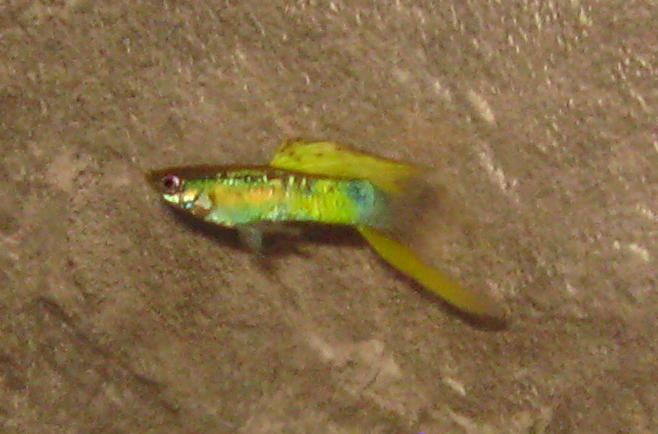
Blond Lower Sword w/Mg (bred by Alan S. Bias)
In the above example are two sibling males.  The upper is a Grey Lower Sword w/Mg and yellow pigment.  The lower is a Blond Lower Sword w/Mg and yellow pigment.  The latter would meet IFGA criteria for IFGA Gold class if he possessed a delta tail.  I photographed these two males with deflected flash after a period of nearly two hours in total darkness, sometime after midnight.  The purpose was two fold;  1.  First to show motility of yellow color pigment, in that the fish are able to "turn it off", 2.  Second to show that yellow metal iridophores are not (or at least very minimally) reactive to reduced light and motility.

Attempts by breeders, such as Luke Roebuck and others, to show "improved" delta strains within the IFGA Gold class have, to date, met with resistance.  While I visualize and breed my guppies based on phenotype, for understanding I often interpret results as an expression of genotype.  Unfortunately, this is in direct contradiction to IFGA phenotypical judging.  Breeder successes in improved "Golds" resulting from combinations of Metal (Mg) + Asian Blau (Ab) + Blond (bb) can result in near full body expression.  This form of amplification of expression via combination is similar to Asian bred Full Platinum's that result from Metal (Mg) + Half-Black (NiII) + Blond (bb) .  Yet, in combination with yellow pigment such fish are only regularly "downgraded" to Yellow Delta classes when not disqualified.  Despite IFGA Gold body color being determined prior to (Yellow) Caudal Color on IFGA classification charts.  There continues to be a lack of willingness to accept "Full Golds" on equal terms to traditional IFGA Golds with patches of metal and translucent regions of color.   All that is required is a minimum of 25% gold body color, in the form of Metal (Mg) in combination with Blond (bb) with or without Purple Body Mutation (Pb).
Asian Blau Schimmelpennig Platinum (bred by Alan S. Bias)

Herman Magoshitz Full Yellow w/Mg (photo courtesy Luke Roebuck)

Summary:  During the past 15 years I have primarily concentrated my breeding's heavily on both gold  iridophore pigment and yellow color pigment in Lower and Double Swords.  Both in grey and blond body fish.   I have found each to be extremely "moody" in nature.  The yellow color pigment by direct influence of the mood of fish as individuals or stress related events, and the gold iridophore pigment by autosomal influence.  Otherwise, the latter is fairly static.  Over the last three years I have additionally focused on the addition of Asian Blau (Ab) to this equation.  In general, in the mornings my entire fishroom can appear as tank after tank of white finned fish with gold striping in the fins and body.  By early afternoon in natural or handheld incandescent lighting it is just the opposite.  Tank after tank of yellow finned fish.  The following photographs exemplify the effects of metal in both grey and blond fish.  Some of which would meet criteria for IFGA Gold if in delta form.

Grey Vienna w/Mg (bred by Alan S. Bias)
Asian Blau Grey Vienna w/Mg (bred by Alan S. Bias)
Blond Vienna w/Mg (bred by Alan S. Bias)
Asian Blau Blond Vienna w/Mg (bred by Alan S. Bias)
Grey Vienna Pb w/Mg (bred by Alan S. Bias)
Asian Blau Grey Vienna Pb w/Mg (bred by Alan S. Bias)
Blond Vienna Pb w/Mg (bred by Alan S. Bias)
Asian Blau Blond Vienna Pb w/Mg (bred by Alan S. Bias)

 ~~~~~~~~~~~~~~~~~~~~~~~~~~~~~

There is often no right or wrong when it comes to raising Guppies.
  Though sometimes a better course of action to meet desired results.
  Post your results in publication or by entry in a show.
  Help Guppy Breeding persevere.  

~~~~~~~~~~~~~~~~~~~~~~

Click on blog photos to enlarge

Click on blog photos to enlarge